SpaceX's Starship Reaches Orbit for the First Time
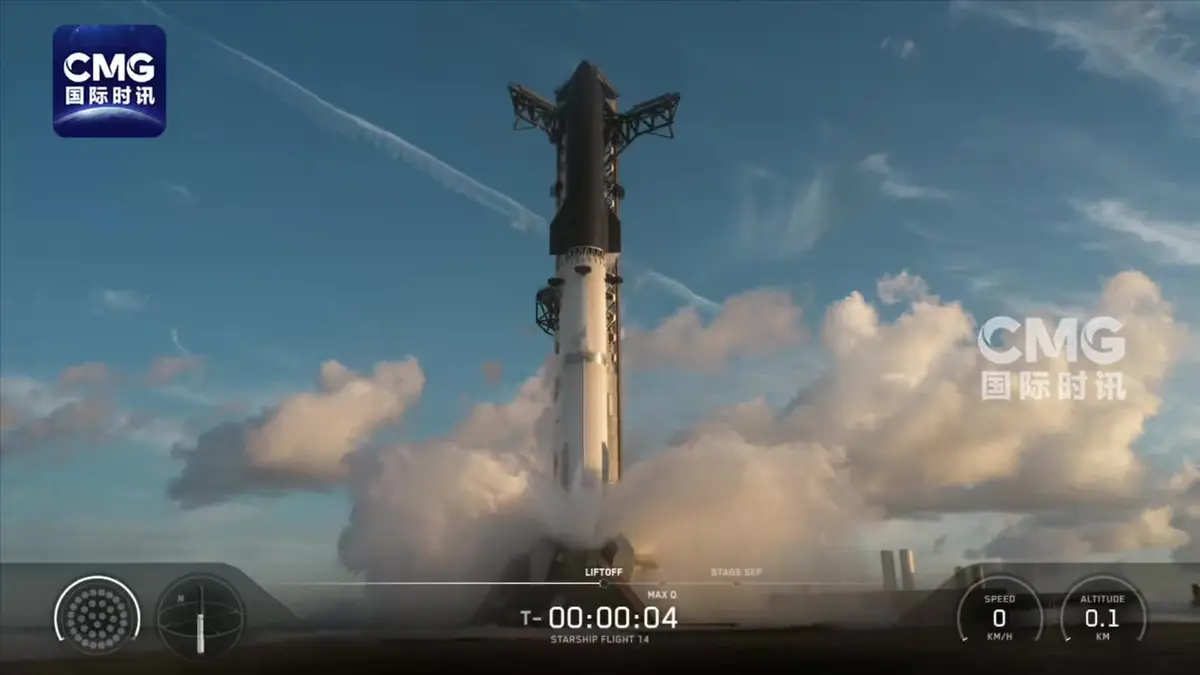
SpaceX reached a long-awaited milestone on September 28, sending the upper stage of its giant Starship rocket into Earth orbit for the first time. The 14th test flight lifted off from the company’s Starbase facility in southern Texas at 8:48 p.m. Beijing time, carrying 26 next-generation Starlink V3 satellites. All 26 were successfully deployed in orbit, according to SpaceX.
Roughly six minutes and fifty seconds after liftoff, the Super Heavy booster, designated B21, completed its planned splashdown in the Gulf of Mexico. Neither the booster nor the ship was caught by the launch tower’s mechanical arms on this flight; instead, both were designed to come down in the water, with the ship originally expected to splash down near Australia after a flight of several hours.
The mission did not go entirely to plan. One of the ship’s vacuum engines malfunctioned, leaving the upper stage, known as S41, able to complete only part of its intended profile about 25 minutes into flight. SpaceX had hoped the ship would circle the planet roughly six times over nearly ten hours before reentering the atmosphere. Even so, the flight achieved its headline objective: reaching orbit.
Starship is the largest rocket ever built, designed to be fully reusable. Its two stages are meant to return to the launch site and be caught by the tower, a feat SpaceX has previously demonstrated with the booster but not yet with the ship. Full reusability is central to the company’s plans to slash the cost of launching cargo and people, both for Starlink, its satellite internet constellation, and for future missions beyond Earth orbit.
The 26 satellites aboard were Starlink V3 craft, a larger and more capable generation than earlier models. Deploying them on Starship matters because the rocket’s wide payload bay and lifting capacity allow far more satellites per launch than the Falcon 9 rockets SpaceX currently uses for most Starlink missions.
For observers in China, the test was closely followed by technology and business outlets including ITHome, 36Kr and Cailian Press. China has its own reusable rocket efforts underway, and Starship’s progress is widely treated as a benchmark for how quickly fully reusable launch systems can move from demonstrations to regular service.
SpaceX has framed the test campaign as iterative: each flight is expected to expose problems that engineers fix before the next attempt. The engine failure on this mission fits that pattern, and the company has not indicated it will slow the pace of launches. A return to flight is expected in the coming months.
If Starship can reliably reach orbit, deploy satellites and eventually land both stages intact, it would give SpaceX a vehicle capable of carrying far heavier payloads than any rocket flying today. For now, the company can claim a first: its spacecraft has flown in orbit, and its satellites have been released there.