Esports Stays in Asian Games, Olympic Council Says After Rumors
Esports will not be dropped from the Asian Games after this year’s edition, the Olympic Council of Asia (OCA) said on September 28, pushing back against a wave of reports that the fast-growing medal sport was about to be moved out of the region’s flagship multi-sport event.
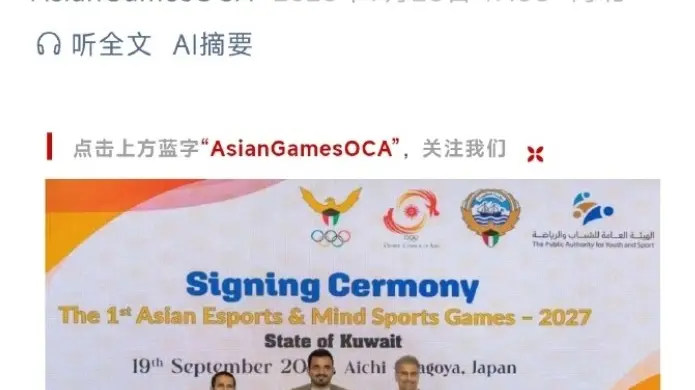
In a statement sent to the Xinhua news agency, the OCA said the rumors “do not match the council’s work arrangements.” The clarification followed multiple Chinese media reports suggesting that esports would exit the Asian Games after the Aichi-Nagoya Games, which are currently being held in Japan, and would instead be folded into a new separate event. The OCA confirmed it signed a host city contract with Kuwait on September 19 for the first Asian Esports and Mind Sports Games, to be held in 2027.
The council’s message appears to be that the new Kuwait event is an addition to the calendar, not a replacement for esports at the Asian Games. For players, federations and fans, that distinction matters enormously. The Asian Games is one of the few major international multi-sport events where esports medals count toward a national tally, giving titles a weight that standalone tournaments cannot match.
The timing of the denial was striking, because it landed on the same day China was celebrating one of its most lopsided esports victories. In the Honor of Kings final at Nagoya, China beat Malaysia 4-0 to defend its title, a result that triggered congratulatory posts from the Chinese Olympic Committee and from studios across the industry. Honor of Kings is a mobile multiplayer online battle arena game developed by Tencent, and it has become a pillar of China’s esports ambitions.
The win also produced a personal milestone. Mid-laner Huang Yaoqin, known in competition as Qingrong, became only the second player in the history of China’s King Pro League to complete a career grand slam, following Luo Siyuan, or Huahai. Qingrong has now won titles across the league’s winter, spring and autumn splits, the World Champion Cup and the Esports World Cup, and added an Asian Games gold to the list.
Even China’s coach struck a note of caution. In a post-match interview, coach Naicha said Malaysia had improved significantly and that his team had actually trailed in practice matches, a reminder that the gap at the top of Asian esports is narrowing even as the scorelines look one-sided.
China’s broader esports scene, however, is not all celebration. At the Valorant Shanghai Champions event, Chinese teams lost all of their opening-round matches, prompting one well-known player, Liu Qingsong, to vent publicly about the level of preparation. The contrast between China’s dominance in mobile titles and its struggles in some PC shooters is a live topic among domestic fans.
For global readers, the OCA’s statement settles the immediate question: esports remains an Asian Games medal sport for now, with a new dedicated Asian esports event arriving in Kuwait in 2027. Whether the two competitions complement or eventually compete with each other is a question the next few years will answer.