China's Holiday Train Rush Shows Scale of Domestic Travel
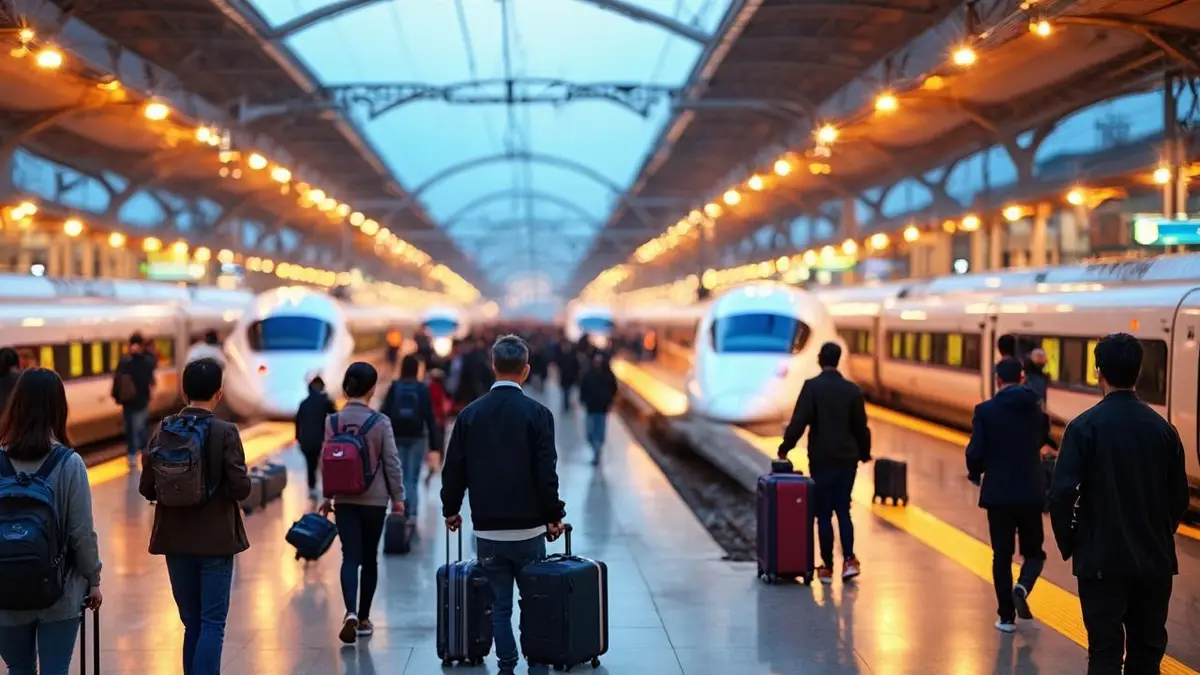
China’s railway network is once again proving why it is the backbone of domestic travel. On September 27, the final day of the Mid-Autumn Festival mini-holiday, the Shanghai branch of China Railway Group said it expected to carry 3.32 million passengers across the Yangtze River Delta region — the vast economic zone around Shanghai that includes parts of Jiangsu, Zhejiang and Anhui provinces. The day before, the same operator had already moved 2.808 million people, a jump of 27.8 percent compared with the same day last year.
The Mid-Autumn Festival, a traditional holiday centered on family reunions and mooncakes, has become a major travel period in its own right. In 2026 it fell close to the National Day holiday, creating a dense cluster of days off that many Chinese workers use to visit relatives or take short trips. The result is a familiar pattern: millions of people moving in the same direction at the same time, and a rail system that must absorb the surge without breaking.
To handle the return wave, the Shanghai branch said it added trains and extended service hours on key routes. The Yangtze River Delta is one of the world’s most densely populated and economically productive regions, and its rail corridors — linking Shanghai, Hangzhou, Nanjing, Suzhou and Hefei — are among the busiest in the country. Even a modest holiday can push those lines to their limits.
A new piece of infrastructure is set to arrive just in time. The Xiong’an-Shangqiu section of the Beijing-Hong Kong high-speed railway will open on September 28, adding a fresh north-south channel. The line is expected to strengthen the network effect of China’s high-speed rail grid and improve connections between several Anhui cities and Beijing. Places such as Jiuhuashan, Lujiang, Shouxian, Tongcheng and Bozhou may see direct high-speed trains to the capital for the first time.
For travelers, that means shorter journeys and more options. For local economies, it can mean easier access to tourists, business visitors and investment. Anhui has long been a source of migrant workers for Shanghai and other coastal cities; better rail links make it easier for families to stay connected and for smaller cities to plug into the region’s growth.
China’s high-speed rail network now spans more than 40,000 kilometers, far larger than any other country’s. The system is designed not only for speed but for capacity, with trains running at frequent intervals and stations built to handle large crowds. During peak holidays, operators often run extra services late into the night, and ticket sales open weeks in advance so travelers can plan.
Still, the holiday rush is a reminder of how concentrated travel can be. Stations in major cities become temporary cities of their own, with queues for security, food and taxis. Authorities regularly urge passengers to arrive early, travel light and use digital tickets to speed up entry.
For global readers, the numbers may seem staggering, but they reflect a simple fact: in China, rail is how the country moves. Whether it is a student going home, a grandparent visiting grandchildren or a tourist heading to a mountain temple, the train remains the default choice. As the Mid-Autumn holiday ends and the National Day travel season looms, the Yangtze River Delta’s rails will keep humming — a quiet but powerful engine of Chinese daily life.