The Curious Case of the Egyptian Statue That Turned Itself
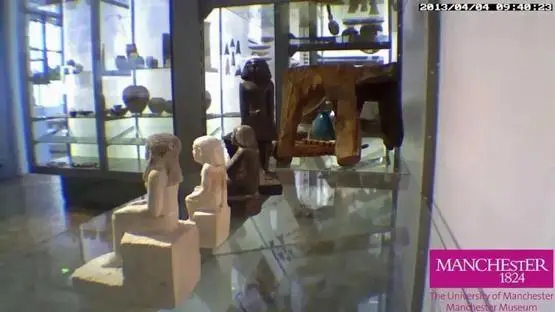
In February 2013, Campbell Price, an Egyptology curator at the Manchester Museum in England, noticed something odd inside a display case. A small ancient Egyptian figurine, roughly 25 centimeters tall, had turned around. He came back later and found it had shifted again. The next day, its direction had changed once more. Strangely, the other artifacts sharing the same case stayed perfectly still.
The figurine is a funerary statuette carved to represent a deceased person, a common object in ancient Egyptian burials. It had been placed facing outward, toward visitors. Then it began, apparently, to face the wall. Price said he was puzzled, and a little unnerved. He had never seen anything like it in the museum’s Egyptian collection, which is one of the oldest and most respected in Britain.
Rather than dismiss it, the museum decided to investigate properly. Curators mounted a time-lapse camera and filmed the display case continuously for a full week, capturing the statue’s position frame by frame. If something supernatural was happening, the footage would show it. If something ordinary was happening, the footage would show that too.
What the camera revealed was a quiet, mechanical explanation. The figurine sits on a glass shelf, and glass is not perfectly flat. It also absorbs and releases moisture as the surrounding air changes. Visitors walking past the case add tiny vibrations and shifts in temperature. Over hours, the statue’s base slowly crept across the uneven surface, nudging it a few degrees at a time. The rotation was real, but it was the building, the air and the glass doing the turning, not the ancient Egyptian who was buried with it.
Price, who has a background in archaeology rather than paranormal studies, has been open about the whole episode. He has described how the story spread far beyond Manchester, with headlines around the world calling the object a cursed or haunted statue. In his view, that framing misses the more interesting point. Museum objects live in complicated physical environments, and small forces acting over long periods can produce results that look deliberate.
There is a broader lesson here for anyone who cares about how science handles surprising claims. The museum did not simply laugh off the report, and it did not leap to a supernatural conclusion either. It gathered evidence, in this case a week of images, and let the data settle the question. That is a modest version of how research works at every scale, from a glass shelf in a regional museum to a telescope pointed at a distant galaxy.
For visitors, the episode has become part of the appeal. People come to see the statue that moved, and they leave having learned something about humidity, vibration and the surprising restlessness of old objects. The figurine still stands in its case, still slowly shifting by fractions of a degree, still drawing a small crowd. It is a reminder that curiosity, carefully followed, usually pays off, and that the most ordinary explanation can be more satisfying than a ghost story.
The museum has since used the case to talk about conservation and how fragile ancient materials react to modern buildings. Temperature swings, humidity and even foot traffic all leave their mark on objects thousands of years old. For the curators, the mystery was never really about the afterlife. It was about keeping a very old, very delicate thing safe in a very busy public space.