Anthropic Drops Git for Its Own AI-Era Version Control System
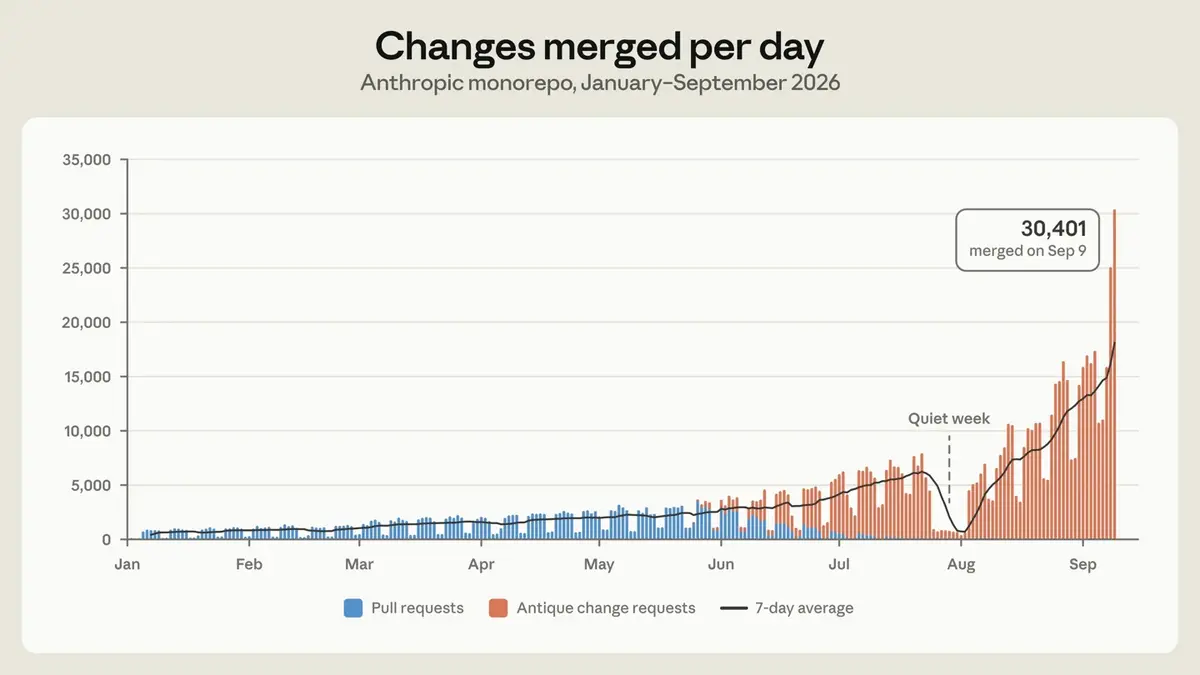
Anthropic, the American AI company behind the Claude models, has announced it is retiring Git — the version control system that has quietly governed how programmers work for roughly two decades — in favour of a homegrown replacement called Scion. The company says it made the switch because its own AI agents were generating code changes far faster than Git could comfortably absorb.
Git is a distributed version control system: every developer keeps a full copy of a project’s history on their own machine, and changes are merged through a shared repository. That design made sense when humans typed the code. Anthropic’s problem is different. The company says its teams were merging about 2,500 code changes a day in May. By September, that figure had passed 30,000 a day — a more than tenfold jump in roughly four months, driven largely by automated agents doing work that once required people.
Scion changes the architecture. Rather than shipping large amounts of source data down to each machine, it moves most source code management operations onto servers, so agents and automation tasks need to download far less. The logic is straightforward: if most of the contributors are software programs that only need a slice of the codebase at any moment, the traditional model of cloning everything locally becomes wasteful.
According to Chinese tech outlet IT Home, the new system was reportedly built by a very small team working with Claude itself, a detail that has circulated widely in developer communities. If accurate, it is a neat illustration of the moment: AI tools being used to rebuild the infrastructure that AI tools depend on.
The story landed on Zhihu’s trending list and triggered a familiar debate. Git is not just software; it is a shared habit. Developers learn its commands the way they learn a keyboard layout, and an entire industry of hosting platforms, code review tools and continuous integration services is built around it. Replacing it inside one company is one thing. Replacing it as an industry default is another.
There is also a practical question of trust. Version control is the memory of a software project — the record of who changed what, when, and why. Any system that centralises more of that on servers trades some of Git’s decentralised resilience for speed and efficiency. For companies running fleets of coding agents, that may be the right trade. For open-source projects scattered across the world, it may not be.
What Anthropic’s move signals is less about one company’s tooling choices and more about a shift in who writes code. When agents become the primary contributors, infrastructure designed for human workflows starts to strain. Expect more experiments like Scion — and expect the next few years of developer tools to look quite different from the last twenty.