Neanderthal Genes Still Make Some Modern Humans Taller and Stronger
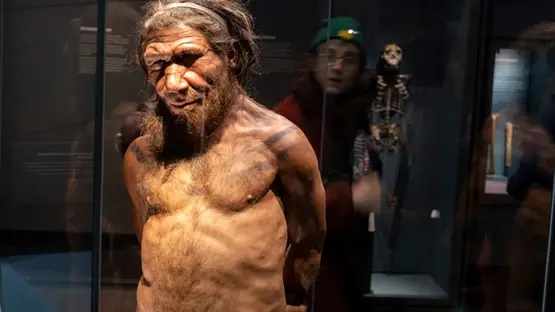
Roughly 40,000 years after the last Neanderthals disappeared, a small piece of them is still walking around inside many of us. A new study has identified two inherited genetic changes from the extinct human species that make modern carriers taller and more muscular than people who lack them. The findings were reported by the Chinese science outlet Guokr, drawing on recently published research.
Neanderthals lived across Europe and western Asia from about 300,000 to 40,000 years ago. They were built differently from us: thicker bones, a more prominent brow ridge, and a stockier, stronger frame. When early modern humans left Africa and encountered them, the two groups interbred. Most people alive today outside sub-Saharan Africa carry a small percentage of Neanderthal DNA — typically one to two percent.
What the new work shows is that not all of that legacy is inert. The two variants in question appear to influence how the body builds bone and muscle. Carriers tend to grow taller and develop greater muscle mass than non-carriers, according to the study. In other words, a tall, broad-shouldered friend may owe part of that physique to genes inherited from a species that vanished before writing, farming or cities existed.
The distribution of these variants is striking. They are most common in populations with South Asian and East Asian ancestry, the research notes. That geographic pattern is a reminder that human evolution did not stop when our species spread across the globe. It continued through ancient interbreeding, and the results are unevenly spread depending on where your ancestors lived and who they met.
The study fits into a broader effort to understand what Neanderthal DNA actually does in living people. Previous research has linked inherited Neanderthal sequences to traits ranging from immune response and skin and hair variation to sleep patterns and pain sensitivity. Some of these variants appear helpful; others seem to have been gradually weeded out by natural selection. Untangling which is which requires large genetic datasets and careful statistics.
There is an important caveat. Genetic variants rarely act alone. Height and muscle mass are shaped by hundreds of genes plus nutrition, exercise, childhood health and environment. A Neanderthal variant that nudges someone upward by a centimeter is not destiny. It is one small input among many.
Still, the finding is a neat illustration of how deeply intertwined our species’ story is. Modern humans and Neanderthals were close enough to have children together, and their descendants survived. The physical differences that persist today are not just accidents of recent history; some trace back tens of thousands of years to encounters on the edges of ice-age Europe and Asia.
For readers outside the field, the takeaway is simple. Human ancestry is a braided rope, not a single clean line. The next time you notice a particularly sturdy relative, you can reasonably wonder whether a little Neanderthal inheritance is at work — and you would not be entirely joking.