Fuyang: The Small City Building a 'Rice-Character' Rail Hub
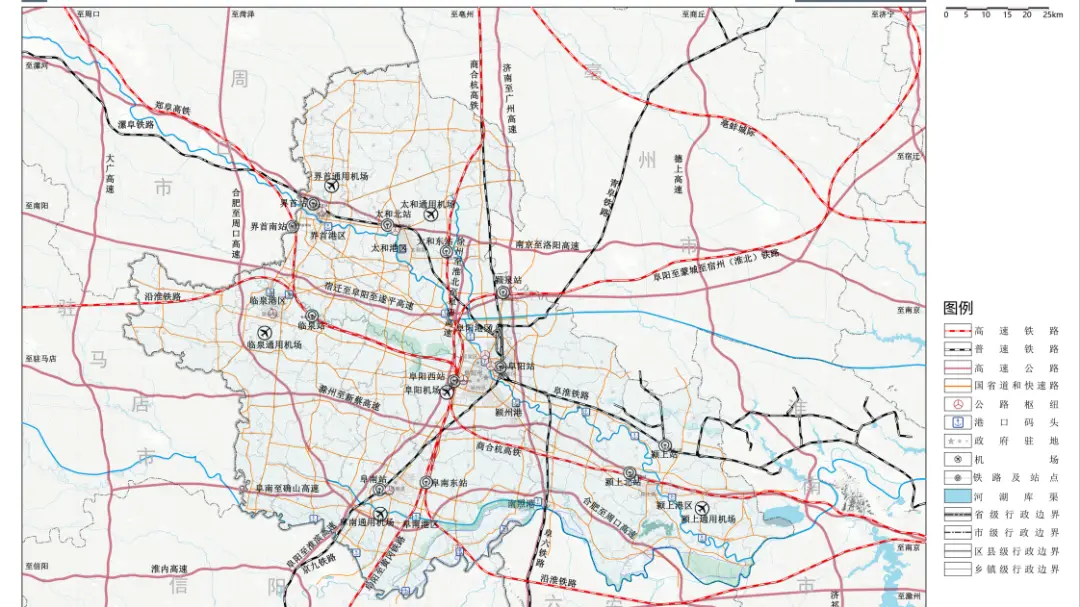
Most Chinese cities dream of a single new railway station. Fuyang, a prefecture-level city in northwestern Anhui with a population of roughly eight million, is aiming for something far grander: eight directions of track converging on one point. In Chinese planning slang that pattern is called a “rice-character” hub, after the character 米, whose strokes radiate out in every direction.
Fuyang’s bid moved a step closer this month. China’s environment ministry published the environmental impact review for the Fuyang–Huanggang high-speed line, a procedural milestone that clears the way for the project to enter its final pre-construction phase. The route would run southwest from Fuyang through parts of Anhui, Henan and Hubei provinces, linking a string of cities that have long sat off the main trunk lines.
The line is not a minor spur. It forms a key segment of the Beijing–Hong Kong (Taiwan) corridor, one of the eight north-south and eight east-west arteries in China’s national high-speed rail blueprint. Fuyang already sits on the Beijing–Hong Kong line that opened in 2019, and further connections are planned or under way toward Hefei, Zhengzhou and other regional centres.
What makes Fuyang unusual is its timing. For years the race to build a rice-character hub was fought almost entirely among provincial capitals — cities such as Zhengzhou, Hefei, Changsha and Xi’an, each spending heavily to become the dominant crossroads of its region. The competition is expensive and, so far, inconclusive. Which city truly deserves the title is still disputed.
Now smaller cities are joining in. Fuyang is not a provincial capital, and it is not a coastal boomtown. It is a farming and manufacturing centre that for decades exported workers to the coast. Better rail links change that equation: they cut the travel time to provincial capitals and coastal job markets, and they make it practical for factories and logistics firms to place operations inland, where land and labour cost less.
That logic has already reshaped other inland hubs. Zhengzhou, once a modest rail town, turned its position on the national network into an air-freight and electronics manufacturing cluster. Hefei, a few hours east of Fuyang, used its rail and research base to attract display and electric vehicle industries. Fuyang’s planners are plainly hoping for a smaller version of the same story.
Construction still requires final approvals, and the timetable for breaking ground has not been announced. But the environmental review is the point at which a line stops being a drawing and starts being a project. If Fuyang succeeds, it will be the first ordinary prefecture-level city in China to assemble a full eight-direction rail hub — a small city, in effect, teaching the big ones that the map is never finished.