The Ancient Village Walled In by a Giant Natural Stone Gate
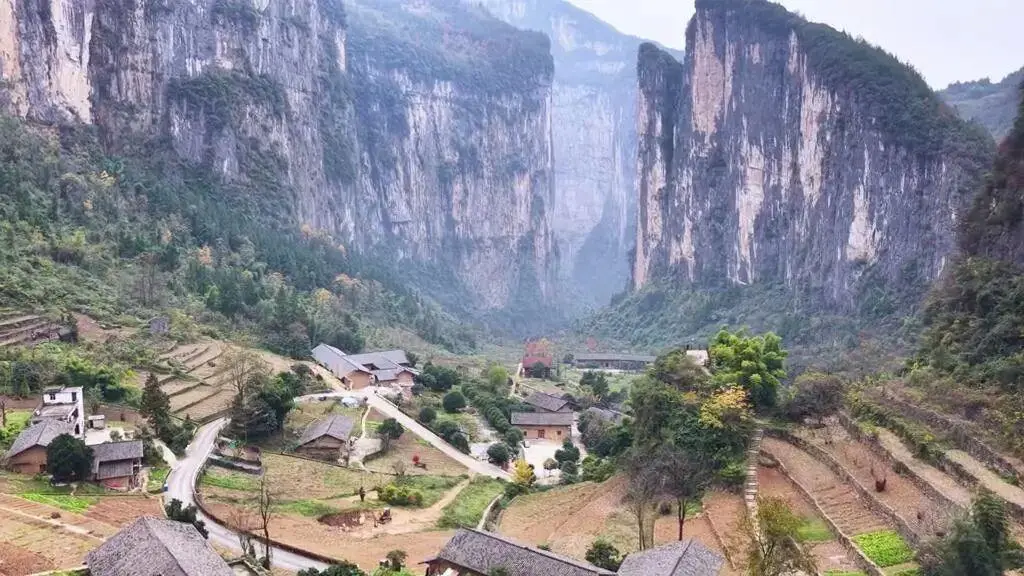
In the deepest folds of the mountains around Fengjie County in Chongqing, southwest China, there is a village that geography seems to have tried to hide. Three sides of the settlement are pressed against sheer cliffs, so steep and so tall that they wrap the village like the walls of a fortress. The only obvious way in or out runs through a gap in the rock: a natural stone gate hundreds of meters wide, with cliff faces rising on either side as if a giant had split the mountain with a single axe blow.
Locals call this opening Han Kuimen, which translates roughly as the Dry Kuimen. The name is a deliberate echo of a far more famous landmark. The original Kuimen is the dramatic gorge on the Yangtze River, celebrated in Chinese poetry for centuries and printed on the back of the ten-yuan banknote. Han Kuimen sits on dry land rather than over water, but its outline and its steep, imposing profile are strikingly similar. Residents have nicknamed the pair the Twin Heroes of Kuimen, and the dry version is often described as one of the largest natural stone gateways of its kind anywhere.
For travelers, the appeal is the sense of stepping into a place that time and traffic have largely passed by. The village inside the gate has the quiet rhythm of rural mountain life: terraced fields, stone houses, narrow paths, and evenings that arrive early because the cliffs swallow the sun. Because the site is so enclosed, visitors often describe the approach as crossing a threshold rather than simply arriving.
Fengjie itself is familiar to many Chinese travelers as the gateway to the Three Gorges, a region of dramatic river scenery and long history. But the county’s backcountry is far less visited. Roads into these valleys are winding and slow, and much of the final stretch is best covered on foot. That difficulty is part of the attraction. This is not a destination with crowds, ticket queues, or souvenir stalls; it is a place where the landscape itself is the main event.
The discovery of such spots reflects a broader shift in how people travel in China. Instead of only visiting the best-known landmarks, more travelers are seeking out remote villages, unusual rock formations, and landscapes that feel untouched. Social media has accelerated the trend: a single striking photograph of a cliff-framed village can send curious visitors down long mountain roads within weeks.
For now, Han Kuimen remains a quiet wonder. There are no grand facilities, and the experience depends on weather, local guidance, and a willingness to walk. Those who make the trip tend to remember the moment the stone gate opens before them, and the strange, peaceful feeling of standing inside a doorway built by geology rather than hands.