Wengyuan: The Guangdong County Everyone Drives Past
Ask most travelers about northern Guangdong’s Shaoguan and they will name Danzha Mountain’s red sandstone peaks, or the old temple at Nanhua. Push a little further and they may mention the chestnuts of Lechang, the ginkgo trees of Nanxiong, the fortified Hakka houses of Shixing, or the canyon at Ruyuan. Ask about Wengyuan and, in the local essay’s blunt accounting, eight out of ten people pause: Where is that? Next to Xinfeng? Part of Heyuan?
That blank is the first of what the writer calls Wengyuan’s thirty grievances, a list of small indignities suffered by a county that believes it has plenty to show and little recognition for it. The piece, circulating online this week, is less a travel guide than a portrait of a place tired of being the answer nobody gives.
The case for Wengyuan starts with farming. Its agricultural and forestry output has long ranked first in Shaoguan prefecture, and for several years its growth ran among the fastest in the city. It is the kind of quiet economic base that does not photograph well and does not trend on short-video apps.
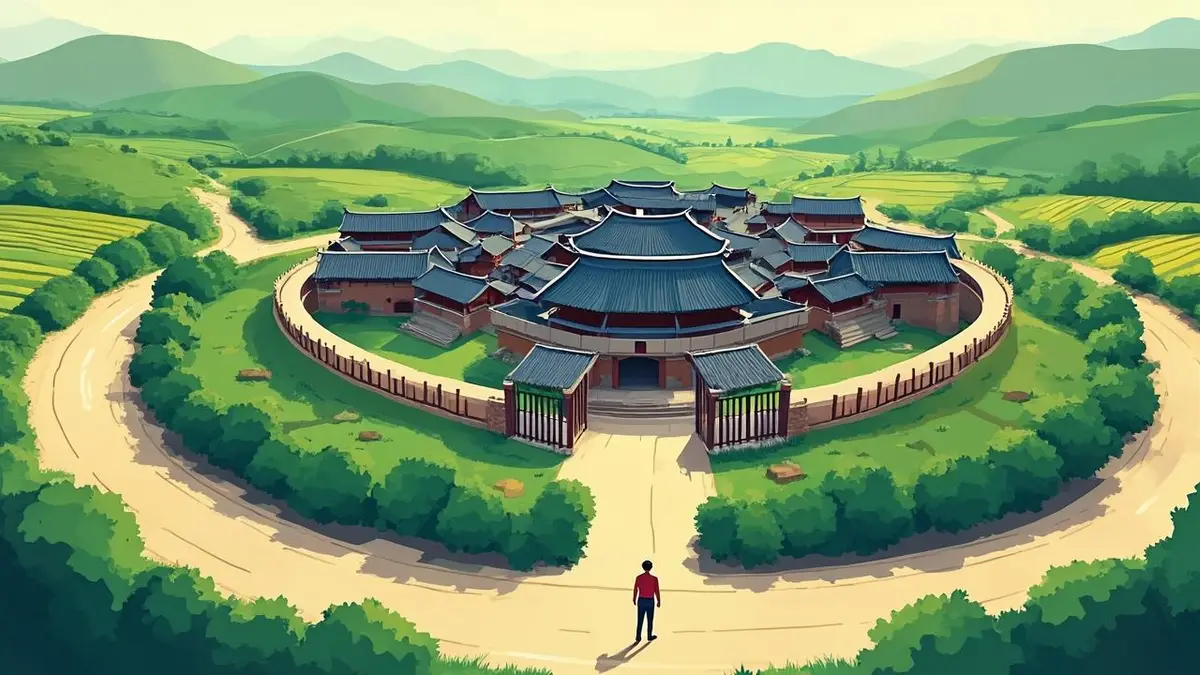
The architecture is another matter. The county holds some of the most distinctive Hakka walled compounds in northern Guangdong, including the Bagua wei, a circular or polygonal fortified village whose name means eight trigrams, and the clustered halls of Huxinba. These are not museum pieces but lived-in structures, built by families who needed walls as much as roofs. For travelers interested in how Hakka communities organized space and defense, they are a serious draw.
The county’s cultural ledger runs deep. Shao Ye, a poet of the late Tang dynasty, came from here, and Chen Lin, remembered for campaigns against coastal raiders in the Ming era, is claimed locally. Modern times produced the oil painter Tu, whose name the essay invokes as evidence that Wengyuan’s talents have always left and been claimed elsewhere.
None of this has translated into visitor traffic. The region’s headline sights sit on a well-worn loop, and Wengyuan sits just off it, close enough to be confused with a neighboring county and far enough to be skipped. The essay’s tone is wry rather than bitter, but the frustration is real: a place can be rich in output, history and craft and still lose the contest for attention.
The practical question for a traveler is whether the county rewards a detour. The answer, on the evidence the essay assembles, is a qualified yes. There is no single blockbuster sight, but there is a dense layer of villages, farmland and local memory that suits slow travel, the kind that values a walk through a walled lane over a ticketed viewpoint. The county’s problem is not scarcity. It is that its assets are spread out and unglamorous, which is exactly the kind of place that rewards curiosity and punishes a checklist.
For a global reader, Wengyuan is a useful case study in how Chinese domestic travel attention concentrates. A handful of names capture the map, and dozens of counties with comparable history remain anonymous. The essay’s thirty grievances are local, but the pattern is national: fame is not distributed by merit, and the places that miss out are often the ones with the most ordinary, and most authentic, texture.