Xi'an After Dark: What Tang Dynasty Curfew Felt Like
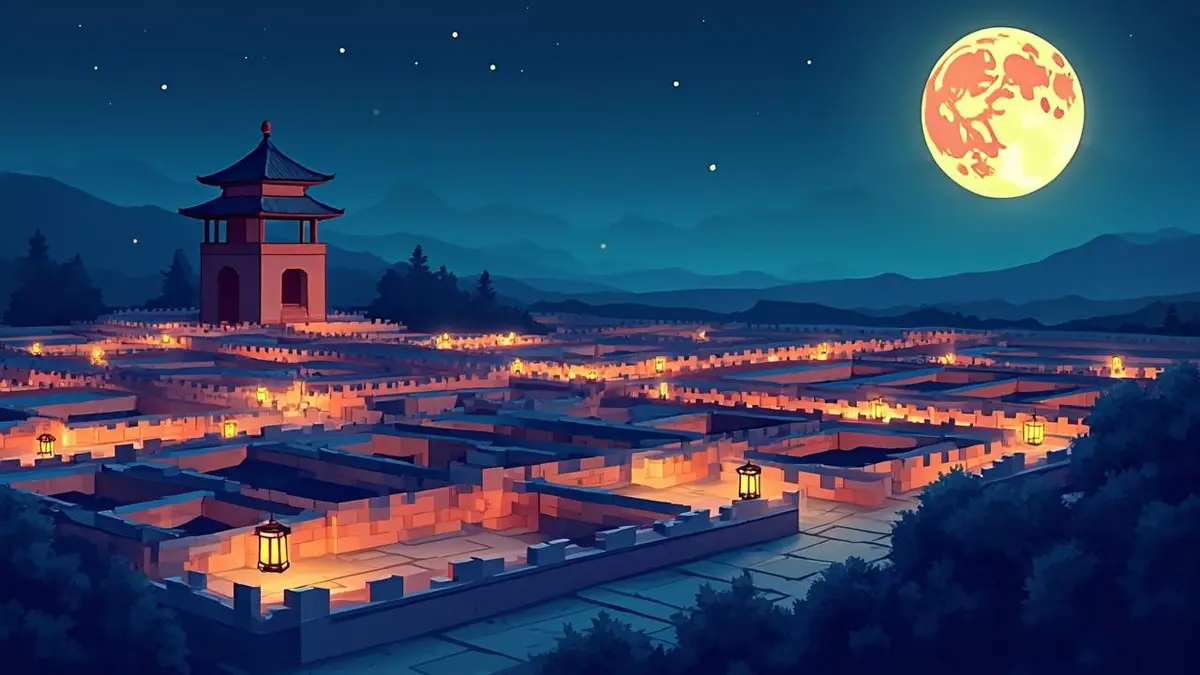
Most visitors arrive in Xi’an expecting the glamour of the Tang dynasty — silk, poetry, foreign traders, lantern-lit markets. A tour leader guiding a study trip along the old Shu Roads route recently offered his group a different picture. Standing near the Drum Tower, with the Bell Tower lit up a short walk away, he opened his evening lecture not with glory but with a ghostly poem about the city after dark.
The verse he read describes six streets falling silent as the drumbeats stop, the avenues empty, the moon shining on nothing. It was written about Chang’an — the Tang capital that now sits beneath modern Xi’an — during the nightly curfew, when the city’s famous nightlife simply ended by law.
To understand why, you have to look at Chang’an’s shape. Unlike the tangled, organic cities most travelers know, the Tang capital was planned like a diagram. It was divided into more than a hundred walled wards, each a sealed rectangle with its own gates, its own market stalls, its own small world. Broad avenues ran between them, wide enough for imperial processions, and the whole design was meant to be seen from above — orderly, legible, and above all, controllable.
That design came with a schedule. At dusk, drums sounded from the drum tower to announce the closing of the ward gates. Anyone still on the main avenues was supposed to be inside a ward, and anyone caught outside without a good reason faced punishment. The streets belonged to the night watch, not to ordinary residents. The poem’s emptiness was not an accident of history — it was policy.
For travelers on a study tour, this is the useful correction. The romantic image of a Tang city glowing with endless festivity is largely a modern invention, shaped by film, television and themed commercial streets. Real Chang’an had a curfew, a rigid ward system and strict limits on who could move where after dark. The city was magnificent, but it was also a machine for keeping order.
That does not make it less fascinating. It makes the details sharper. The markets opened and closed on cue. Residents socialized inside their wards rather than on the boulevards. The grand avenues were ceremonial and administrative spaces, not promenades. Only during rare festivals, when the curfew was lifted, did the whole city spill into the open at once — which is likely why those nights were remembered and written about so intensely.
Guides walking groups through Xi’an today often point out the surviving traces: the Bell Tower and Drum Tower, the rectilinear street pattern, the way the old city still feels boxed in by its walls. Xi’an’s museum collections add the rest — pottery figures, household objects, and maps that show just how small a single ward really was.
For international visitors, the takeaway is simple. Ancient Chang’an was not a free-flowing metropolis but a highly engineered capital, and its nights were quiet by design. Understanding that makes the poetry better, the ruins more legible, and a walk along the city wall after sunset far more interesting than any lantern-lit fantasy.