Meituan's LongCat-2.5 Puts a 1.6-Trillion-Parameter Agent Online
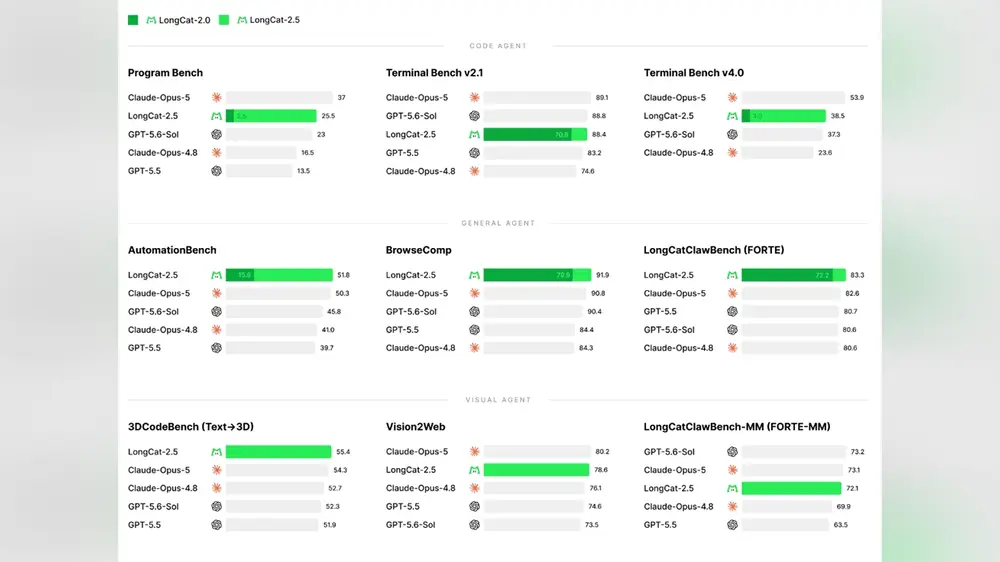
Meituan’s LongCat team released LongCat-2.5 on November 2, a model it describes as natively multimodal and built for long-horizon agent tasks — work where an AI has to plan, use tools and keep going across many steps rather than answer a single question. The headline number is size: 1.6 trillion total parameters, with roughly 48 billion activated for each token the model processes.
That gap between total and active parameters is the key to reading the claim. LongCat-2.5 appears to use a mixture-of-experts design, in which a very large pool of parameters exists but only a small slice is switched on for any given token. The approach lets labs advertise enormous capacity while keeping the computing cost of each response closer to that of a much smaller model. It is now the standard way frontier systems are built, and it means parameter counts say less about real-world speed than they once did.
Meituan says the new version strengthens two things over LongCat-2.0: native visual understanding and agentic coding. Native visual understanding means images are handled inside the model rather than passed through a separate vision module bolted on afterward. On the technical side, the team represents visual signals as multi-level discrete tokens, continuing an approach carried over from the earlier model. Agentic coding covers the kind of work where a model writes and runs code, checks the result and iterates — the loop behind most current AI software tools.
The release is already usable in part. Online experience and API access opened with the announcement, while the model weights are slated to appear on GitHub and HuggingFace soon. That sequencing — hosted first, weights later — has become common for Chinese labs: it lets developers test the model immediately while the company keeps some control over distribution until the open release lands.
Meituan is best known outside China as a food-delivery and local-services app, but it has spent years building an in-house AI research arm. LongCat gives the company a model of its own rather than a dependency on someone else’s API, a pattern increasingly visible across Chinese consumer-internet firms that want AI features woven into shopping, booking and delivery without paying a third party for every call.
The timing is not accidental. The same day’s AI news cycle included DeepSeek open-sourcing a Super-agent architecture and e-commerce listings for AI tokens as a standalone product category during the Double 11 shopping festival. Chinese AI competition has moved from raw benchmark scores toward agents that complete multi-step tasks, and LongCat-2.5 is pitched squarely at that contest.
What remains unproven is the part numbers cannot settle: whether a 1.6-trillion-parameter agent stays reliable over hours of work, and whether the computing bill makes sense for a delivery company’s margins. Independent testing will matter more than the launch post. The next concrete checkpoint is the promised weight release on GitHub and HuggingFace, when outside developers can run LongCat-2.5 themselves and report what it actually does.