October Rewrites China's EV Ranking: Zero, Xpeng, Xiaomi on Top
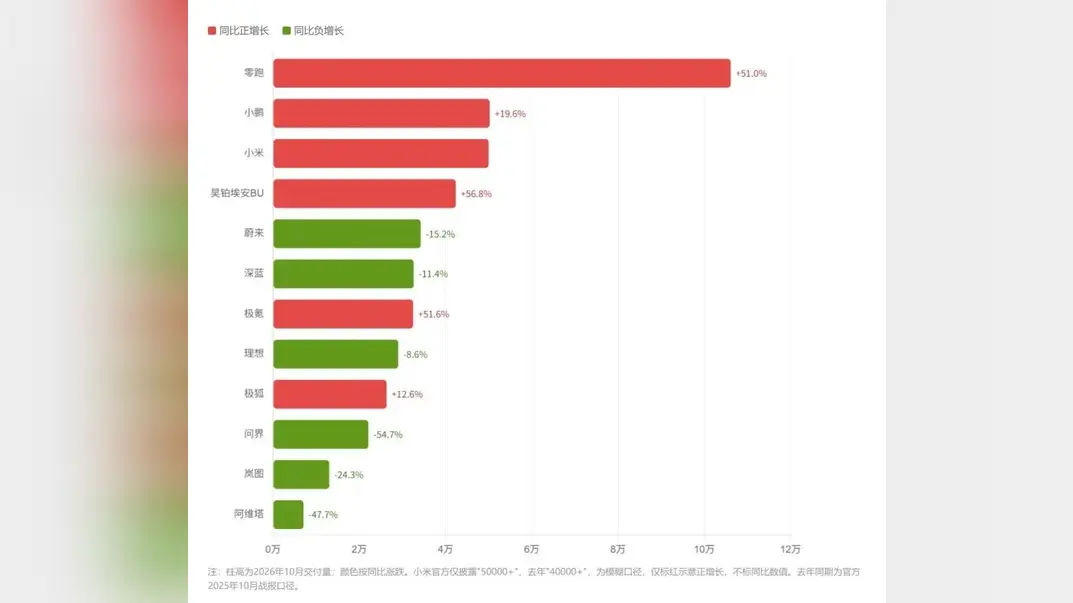
China’s monthly delivery numbers have become the industry’s scoreboard, and October’s version rearranged the top of the table. Leapmotor held its position above 100,000 vehicles for the month, according to figures circulating from the companies’ own disclosures, while Xpeng and Xiaomi each cleared the 50,000 mark. Chinese commentators have started calling the trio “Ling Xiao Xiao” — a shorthand built from the first characters of their names — and treating it as the new front rank of the country’s electric-car upstarts.
The shift is sharper because of who fell. Nio, Li Auto and HIMA — the Harmony Intelligent Mobility Alliance built around Huawei’s car technology — had spent recent years as the safest bets in the segment. In October, all three posted deliveries down both year on year and month on month. For a market that once treated their order books as a proxy for consumer confidence, the reversal is a reminder of how quickly positioning can change in a sector that launches new models almost weekly.
The common thread in the coverage is exports. Growth at home has slowed as subsidies fade and buyers turn cautious, so the companies still adding volume are the ones selling beyond China’s borders. That logic favors brands that invested early in right-hand-drive variants, European dealer networks and Southeast Asian assembly. It also explains why a monthly record at home now counts for less than a shipping manifest.
The pressure is not confined to carmakers. Suppliers are feeling the same squeeze. Xingyu, a leading maker of automotive lighting, reported third-quarter revenue of 3.61 billion yuan, down 8.67% from a year earlier, with net profit down nearly 40% to 262 million yuan. The company also let go of 107 graduates it had recruited, a decision that traveled quickly online. Its first-half figures had looked far steadier, which makes the sudden drop a useful gauge of how fast orders can soften.
Great Wall Motor offers a second view of the same weather. Third-quarter revenue came in at 57.77 billion yuan, down 5.68%, and net profit fell 40.75% to 1.36 billion yuan. The company’s technical reputation, particularly in hybrid powertrains and off-road platforms, has not translated into enough family buyers, and its best-known model, the Haval H6, now competes in a segment crowded with newer electric alternatives.
Changan, meanwhile, shows the split more starkly: overseas sales climbed while profit thinned. That combination — more cars shipped, less money kept — is becoming the defining tension of the year. Analysts quoted in the Chinese coverage argue that rebuilding the balance between growth and profitability may matter more than chasing volume.
Underneath all of it sits a quieter shift in the battery supply chain. Li Auto, Xiaomi, Xpeng and Leapmotor have each outlined plans to develop or co-develop their own battery systems, reducing reliance on CATL, the dominant supplier. Executives frame the move as deeper cooperation rather than a break, but the direction is clear: carmakers want more control over the most expensive part of the vehicle.
For global readers, the takeaway is that China’s electric-car market has stopped being a single story. Volume leadership, export strength, supplier health and battery control are now separate contests, and October suggested that few companies can win all four at once.