Zhuanglang: The Chinese County That Flattened Its Mountains by Hand
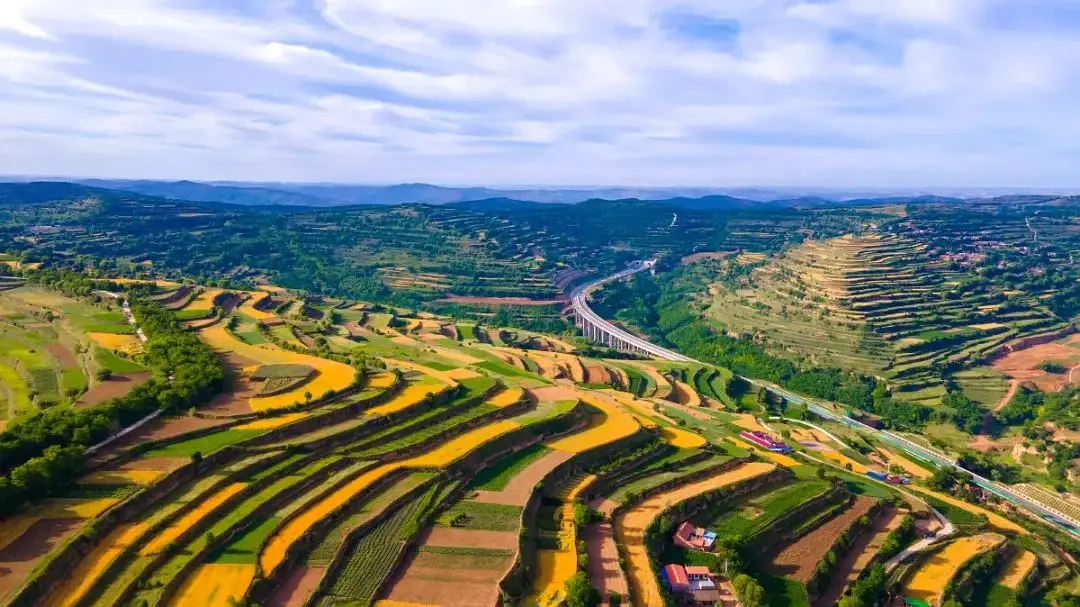
Most travelers who chase China’s terraced landscapes head south, to the famous rice terraces of Longji in Guangxi or Yuanyang in Yunnan. Fewer know that deep in the loess plateau of eastern Gansu province, a county called Zhuanglang spent 34 years doing something quietly extraordinary: flattening its hills.
Zhuanglang is small by Chinese standards — about 1,553 square kilometers and roughly 450,000 residents. It is also old. Buddhist grottoes were carved into its red sandstone cliffs during the Northern Wei period, and later dynasties left their own marks on the landscape. But the county’s modern identity was written by farmers who had little machinery and a great deal of patience.
Starting in the 1960s and continuing for more than three decades, hundreds of thousands of local people worked the slopes with iron shovels, picks and woven back baskets. They moved earth by hand, one load at a time, until steep, rain-scoured hillsides became broad, level fields that could hold water and soil instead of losing both to erosion. The terraces they built are not the postcard curves of southern rice country. They are wide, geometric steps that read almost like architecture — and that is exactly what they are.
The work changed more than the view. Level fields hold moisture, which matters enormously in a dry, loess-covered region where a single bad season can mean a hungry year. Over time, the county’s grain output rose and its soil stopped washing away into the Yellow River. Agronomists and officials from elsewhere in China began visiting to study the approach, and Zhuanglang’s story became a standard reference in Chinese discussions of dryland farming.
For a certain kind of traveler, that makes it a destination. Zhuanglang sits within reach of larger Gansu cities and fits naturally into a loop that includes the better-known grottoes and mountain scenery of the province. Visitors come for the layered fields at sunrise, when the terraces catch the light in long horizontal bands, and for the older attractions: the cliff carvings, the Taoist murals on Zijingshan, the local legends about hermits collecting medicinal herbs in the Guanshan mountains.
What draws people most, though, is the human arithmetic. This was not a single grand project with a ribbon-cutting. It was tens of thousands of ordinary people, season after season, deciding that the mountain in front of them could be different. Guides in the area often say the terraces were built by farmers who simply never stopped.
Travel here remains low-key. There is no theme park, no light show. Accommodation is simple, roads wind through farmland, and the best hours are early and late. That is part of the appeal for visitors tired of crowded holiday landmarks — a place where the main attraction is a landscape shaped by decades of unglamorous work.
Zhuanglang is a reminder that some of China’s most striking scenery is not natural at all. It was made, slowly, by hand. For travelers willing to go a little out of the way, that is precisely the point.