China's AI Data Center Boom Lifts 24 Optical Firms Past 50% Profit Growth
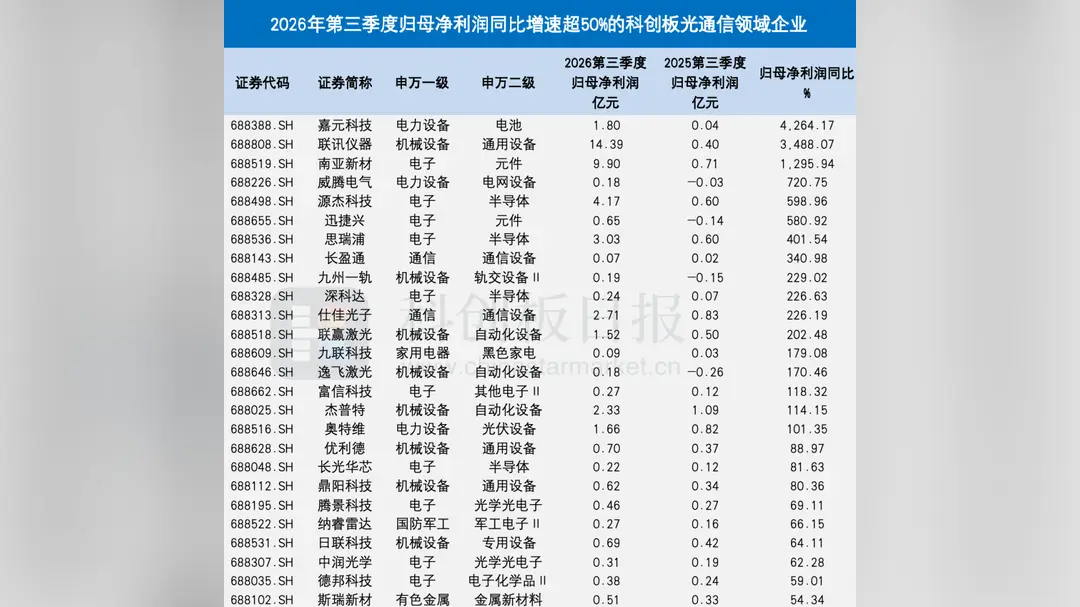
A tight cluster of Chinese optical communication companies has become one of the clearest financial winners of the global AI buildout. According to a survey of 49 such firms listed on Shanghai’s STAR Market, the board reserved for hard-tech companies, 24 reported third-quarter net profit growth of more than 50% year on year. Eighteen posted revenue growth above 50%, and 20 raised research and development spending by more than 30%, a sign that the boom is being reinvested rather than merely pocketed.
The common explanation companies give for the surge is demand from AI computing and data-center construction for high-speed optical interconnects, the fiber-and-laser links that move data between servers and switches. As AI models grow larger and clusters of chips grow denser, copper wiring runs into limits of distance and power, pushing data centers toward optics. That demand is traveling along a chain the survey describes as moving from modules to chips, equipment and materials, lifting suppliers at several layers at once.
Optical modules are the most visible layer. These are the pluggable transceivers that convert electrical signals into light and back again, and Chinese manufacturers have become major global suppliers of them. Higher speeds, from 400G toward 800G and 1.6T, command higher prices and reward companies that can ramp production quickly. The STAR Market, launched in 2019 to fund exactly this kind of hardware company, has given many of them access to public capital to expand capacity.
The profit numbers matter beyond the companies themselves. Optical links are a rare part of the AI supply chain where Chinese firms hold meaningful global share without depending on the most advanced imported chips. The buildout of data centers inside China, alongside exports to overseas cloud operators, gives the sector two engines. Analysts quoted in Chinese financial media have repeatedly pointed to AI computing as the main driver of the group’s earnings, rather than a cyclical rebound in telecom spending.
The picture is not uniformly bright. Component shortages, particularly in lasers and high-end chips, have constrained shipments across the industry, and capacity additions now under way could eventually pressure prices if demand cools. The survey’s finding that a fifth of the firms lifted R&D spending by more than 30% suggests management teams expect the technology race to continue rather than settle.
For global readers, the takeaway is that the AI infrastructure trade has a Chinese hardware chapter that is less discussed than chips but increasingly material. Optical modules are small, unglamorous and indispensable: every large model training run and every cloud service query passes through them. When data-center operators in the United States or Europe add capacity, orders often reach Chinese suppliers.
The signal to watch is the next round of quarterly reports, particularly whether revenue growth keeps pace with profit growth. Profit can expand faster for a while on better product mix and operating leverage, but sustained revenue growth above 50% would show the demand is structural rather than a short squeeze. For investors and supply-chain watchers alike, the STAR Market’s optical names have become a proxy for how fast the world’s AI data centers are actually being wired.