A New Bird Species From 150 Million Years Ago Never Learned to Fly
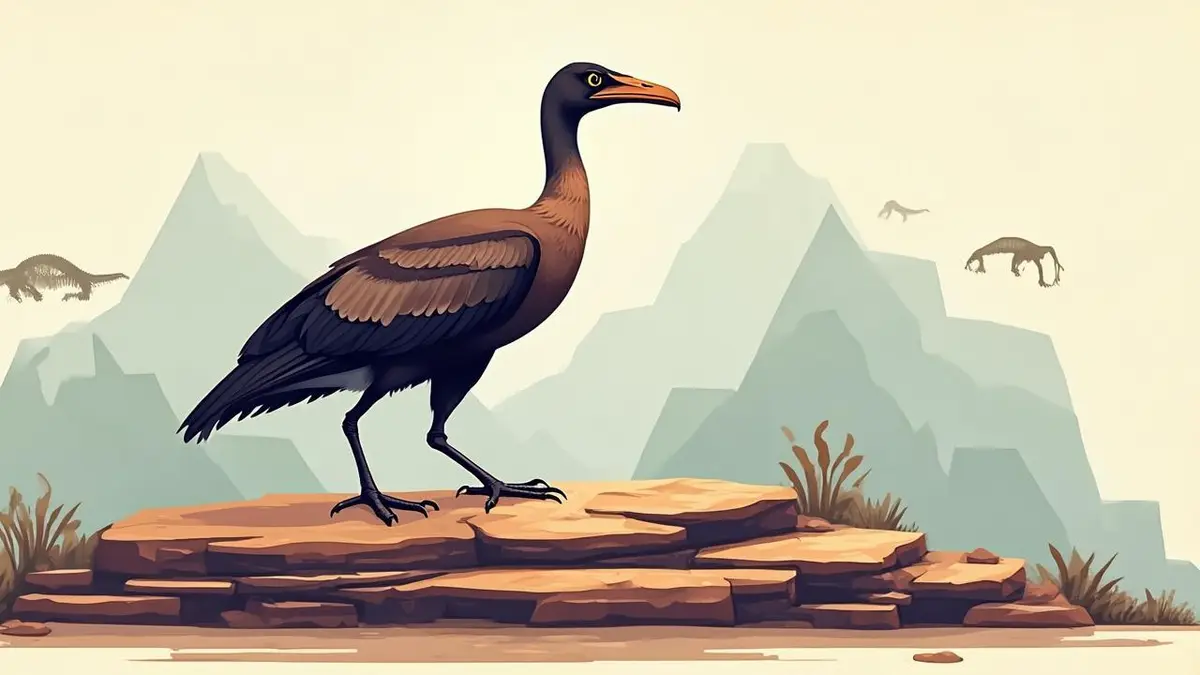
In the hills of Zhenghe county in Fujian province, southern China, researchers have unearthed a bird that lived about 150 million years ago — and it could not fly. Named Yangyuan Yuezhuo, the new species is described in a paper published online on October 14 in Nature, one of the world’s leading scientific journals. At roughly 821 grams, it was about the size of a small chicken, far heavier than the tiny feathered creatures most people picture when they hear the words “early bird.”
What makes the find striking is its anatomy. The bird’s forelimbs were extremely short, leaving no room for wings capable of lifting it into the air. Its hind legs, by contrast, were sturdy and built for running. It also carried a curved, oversized claw on one toe — the same kind of “killing claw” seen in raptor dinosaurs such as Velociraptor. Put together, the picture is of a ground-dwelling hunter that chased its prey on foot rather than taking to the skies.
For decades, the standard story of bird origins has been organized around flight. The assumption was that the very first birds were already gliding or flapping, and that evolution mostly refined what was there. This fossil contradicts that. It shows that in the earliest chapters of bird history, some lineages had already given up on the air entirely and specialized for life on the ground — an ecological path that scientists had not expected to find so early.
Zhenghe is no random dig site. The area’s Jurassic-era lake sediments have produced a steady stream of important bird fossils in recent years, making it one of the most productive windows into the age of dinosaurs anywhere in the world. Each new specimen adds detail to a transition that has fascinated scientists since Darwin: the long, incremental journey from small feathered dinosaurs to the birds that fill our skies and gardens today.
The new species also complicates the notion of a single “missing link.” Evolution rarely runs in a straight line. Instead, early birds appear to have branched into many forms at once, some flapping, some gliding, and at least one — Yangyuan Yuezhuo — sprinting along the ground of what is now Fujian. Flight, in other words, was not the only successful strategy available to the first birds; it was one option among several.
Researchers say the fossil’s combination of features is what makes it scientifically valuable. A running bird with a dinosaur-style hunting claw sits awkwardly between two categories that textbooks usually keep separate, and that awkwardness is precisely the point. It suggests the boundary between “dinosaur” and “bird” was blurrier, and the pace of experimentation faster, than the tidy diagrams imply.
The discovery also underlines how much of China’s fossil record is still being read. The country’s Jurassic and Cretaceous deposits have yielded feathered dinosaurs, early mammals, and ancient insects in extraordinary detail, and each season of fieldwork tends to rewrite some small piece of the evolutionary map. Zhenghe, in particular, now looks like a place where the earliest birds tried out a range of ways to live — and where at least one of them chose to keep its feet on the ground.