An 8,000-Year-Old Face Rebuilt From a Jar of Bones
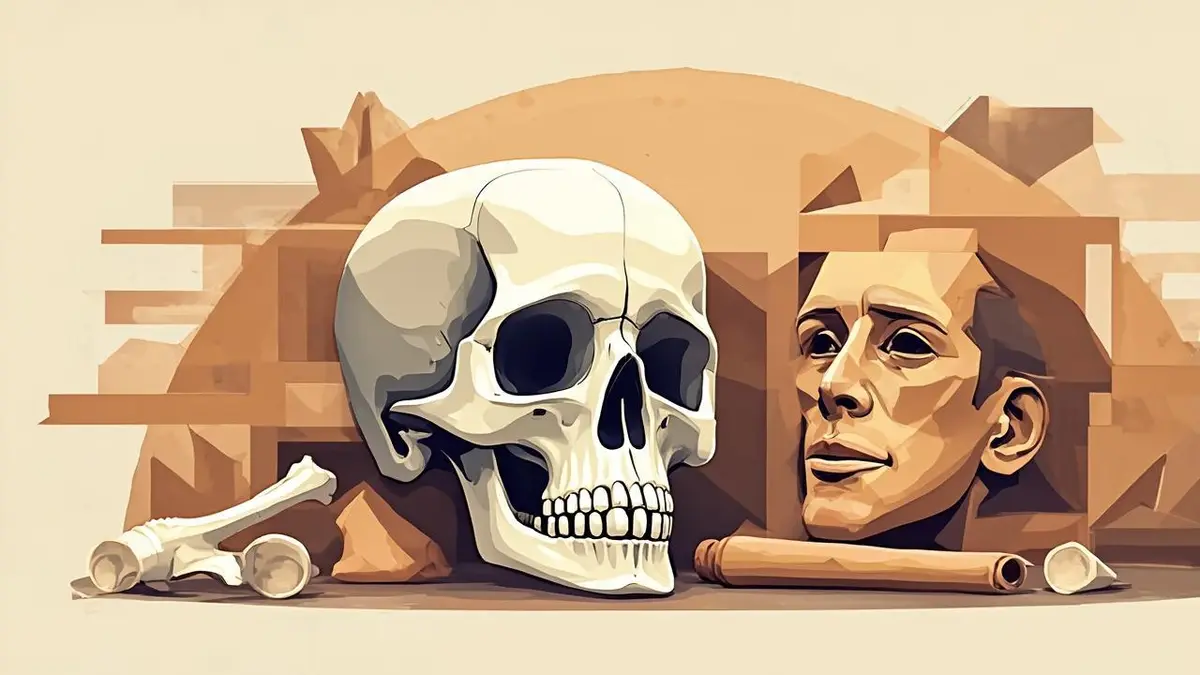
A face last seen roughly 8,000 years ago was unveiled in Zhengzhou, Henan province, this month. Researchers presented a reconstructed portrait of a man who lived at Jiahu, a Neolithic settlement in central China that has quietly become one of the most important archaeological sites in the country.
The reconstruction relied on 3D facial modeling combined with physical anthropology — the study of human bones — to rebuild the soft tissue that once covered a skull. Working from the shape of the cranium, brow ridge, jaw and nasal opening, the team estimated how thick the flesh would have been at each point, then layered muscle and skin back onto the bone in digital form.
Jiahu is not a new discovery. The site dates from about 9,000 to 7,500 years ago and belongs to the Peiligang culture, a farming society that grew millet, kept pigs and dogs, and buried its dead with objects that suggest complex beliefs. Excavations since the 1980s have produced some of the earliest playable bone flutes ever found, along with pottery, rice remains and mysterious markings on turtle shells that some scholars link to the roots of Chinese writing.
That combination is why Jiahu matters well beyond a single portrait. The settlement sits in the core region where Chinese civilization is thought to have emerged, and it is treated as a key reference point in the national project tracing the origins of Chinese civilization. Every new technique applied there — DNA analysis, isotopic studies of diet, and now facial reconstruction — adds a layer to the same question: who were these people, and how did they live?
Facial reconstruction has become a familiar tool in Chinese archaeology. Similar projects have brought back the faces of people from other ancient sites, from Bronze Age burials to much older hominin fossils. The appeal is obvious. A skeleton is data; a face is a person. Museums have found that visitors linger far longer in front of a reconstructed head than in front of a display case of bones.
Researchers also frame the work as a bridge between science and cultural heritage. The same digital methods used to rebuild a face can help monitor fragile objects, document a dig in three dimensions, and share a site with people who will never travel to Henan. The reconstruction announced in Zhengzhou is part of a broader push to turn excavation results into public material — images, models and stories that can travel far from the trench.
For readers outside China, the portrait is a reminder of how deep the country’s archaeological record runs. Jiahu’s residents lived thousands of years before any written dynasty, at a time when farming was still spreading across East Asia. They left no names. What they left was bone, ash, tools and music — and now, approximately, a face.
The next step is more of the same: more genomes, more comparisons, more reconstructions. Each one is a small correction to the imagination, replacing a generic image of “ancient people” with someone specific enough to look at.