Webb Telescope Finds an Atmosphere on a Lava World
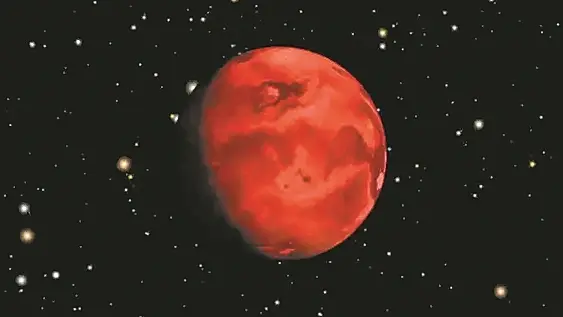
Astronomers have found strong evidence that a rocky planet orbiting a distant star has held on to an atmosphere, a result that pushes against a long-standing assumption about how such worlds evolve. The planet, called HD 3167b, is a so-called lava world, a class of rocky planets that orbit extremely close to their host stars.
The work relied on the James Webb Space Telescope, the most powerful observatory ever launched, which studies the universe in infrared light from a vantage point about 1.5 million kilometres from Earth. Researchers used the telescope to watch the planet as it passed in front of its star, a technique called transmission spectroscopy. By teasing apart the starlight that filtered through any gas surrounding the planet, the team found a signal consistent with a thin atmosphere.
HD 3167b sits in the constellation Pisces, roughly 150 light-years away. It circles its star in less than a day, far faster than Mercury laps the Sun. At that distance, the planet is blasted by stellar radiation, and scientists had generally expected any atmosphere to be stripped away and blown into space.
The planet occupies an odd middle ground. For a lava world, it is relatively cool, but for life as we know it, it is far too hot. Temperatures at its surface could be high enough to melt rock, forming seas of molten material rather than water oceans. That makes it an unlikely home for biology, but a valuable natural laboratory for studying how atmospheres behave under extreme conditions.
What makes the finding notable is that the planet resembles an early Earth in some ways, at least in its rocky composition and its tight bond with its star. Billions of years ago, the young Earth and its neighbours also faced intense radiation from a more active Sun. Understanding which atmospheres survive that phase could help explain why some rocky planets end up bare and others keep a protective blanket of gas.
One possibility is that the atmosphere is not primordial, meaning it was not inherited from the cloud of gas and dust that formed the planet. Instead, it may be replenished from the inside, released by volcanic activity or by the evaporation of molten rock at the surface. If that is the case, the planet could be a window into the interior chemistry of rocky worlds, a subject that is difficult to probe even in our own solar system.
The result is part of a broader wave of exoplanet science made possible by the Webb telescope, which has been used to probe the skies of planets both large and small. Each new measurement adds a data point to the question of how common atmospheres are around small rocky planets, and how long they last.
For now, HD 3167b is a single intriguing case rather than a settled picture. More observations will be needed to confirm the atmosphere, identify what it is made of and work out how it persists. But the early evidence suggests that the boundary between bare rock and gas-shrouded world is blurrier than scientists once thought, and that even planets in extreme orbits may hold surprises.