Global Bond Rout Spreads to Europe as Yields Spike
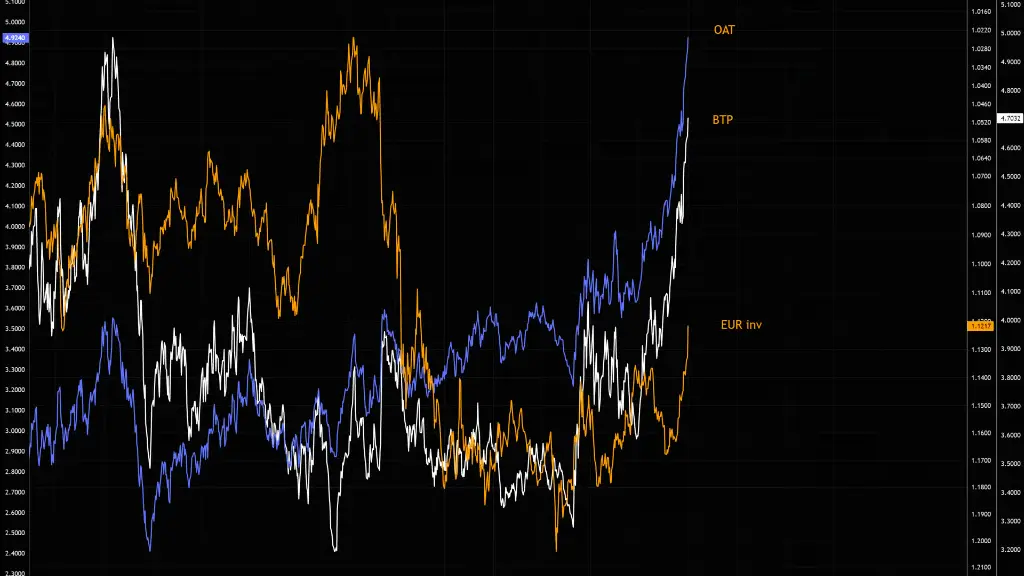
A global bond selloff that began in the United States has spread to Europe, sending government borrowing costs sharply higher and unsettling investors who had assumed the pressure would stay contained on the other side of the Atlantic. The scale of the moves — described by traders as a “black Thursday” for European debt — has revived worries about whether governments can keep funding themselves cheaply.
The details matter. France’s 10-year government bond yield briefly climbed to 4.96%, a level last seen in 2002. The gap between French and German borrowing costs — the so-called spread that investors watch as a gauge of risk — widened to 1.4 percentage points. Italian and Greek yields rose in tandem, while the United Kingdom’s 30-year gilt yield broke through 6% for the first time. These are not small technical moves. They are signs that lenders are demanding more compensation to hold European government debt.
The trigger is partly American. When US Treasury yields rise, global investors tend to reprice everything else, because US government debt is the benchmark against which most assets are judged. A world where Washington pays more to borrow makes European bonds look less attractive by comparison. But local factors are amplifying the move. France has been struggling to form a stable budget, and its fiscal plans carry heavy spending commitments without obvious new revenue. Italy and Greece, both carrying large debt loads relative to the size of their economies, are vulnerable to any shift in sentiment.
There is an irony in the timing. Italy, one of the region’s most indebted economies, nudged up its 2026 growth forecast from 0.6% to 0.8% and said it would ask the European Union for extra borrowing room worth 0.6% of GDP in 2027. The request reflects a simple reality: growth in Europe is slow, and governments want more fiscal space to support it. But that same slow growth makes lenders nervous, because debt is easier to carry when an economy is expanding.
For ordinary households, the chain reaction is indirect but real. Higher government yields feed into mortgage rates, corporate borrowing costs and the price of credit cards and car loans. They also weigh on stock markets, because investors can earn more from safe government bonds and demand a bigger discount to hold riskier assets. Companies that need to refinance debt in the coming months will find it more expensive.
The political backdrop is delicate too. Rumors that European Central Bank President Christine Lagarde might step down early prompted Italy’s economy minister to say publicly that no Italian candidate is ready to replace her, and to call for clarity on the speculation. Markets dislike uncertainty about who runs monetary policy almost as much as they dislike uncertainty about budgets.
What happens next depends on two things: whether US yields stabilize, and whether European governments can convince investors that their borrowing plans are credible. If both fail, the pressure on bonds could deepen. If either improves, the panic may fade as quickly as it arrived. For now, the message from markets is unambiguous: the era of cheap government borrowing is over, and Europe is being asked to prove it can live with that.