China's September Car Sales Fell 28%, and Carmakers Stopped Cutting Prices
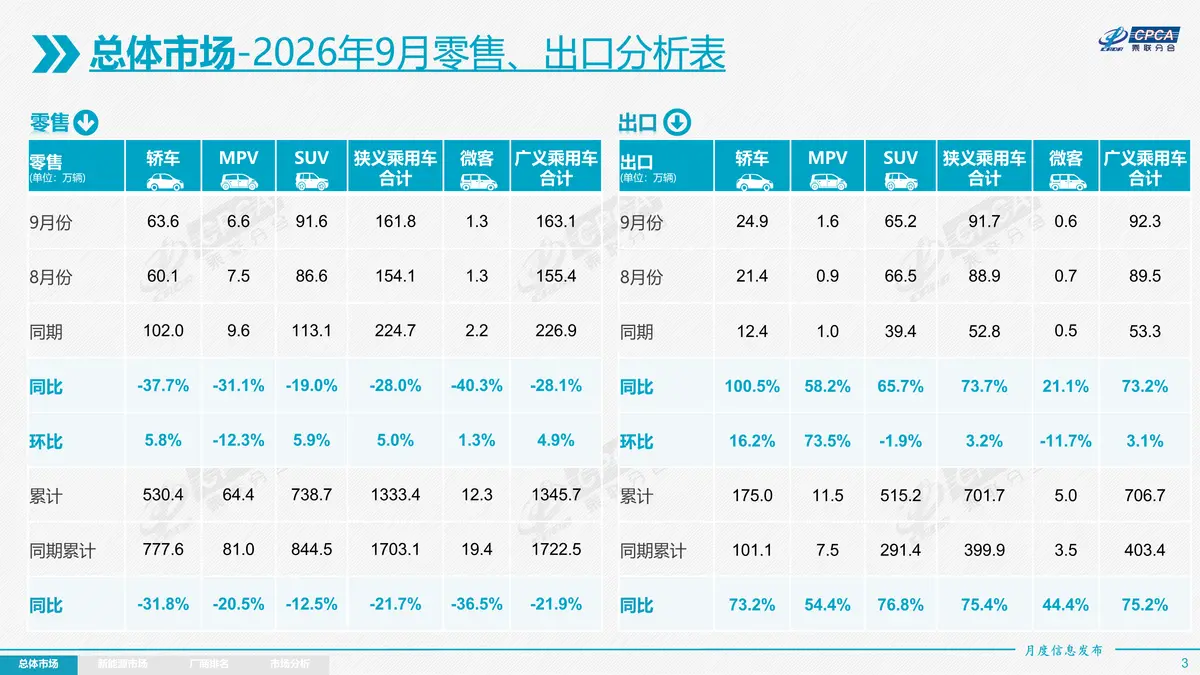
China’s car market just had its worst September in years, and the surprising part is what automakers did not do: cut prices. Retail sales of passenger vehicles fell 28% year-on-year to 1.618 million units last month, according to data from the China Passenger Car Association, the largest single-month decline of 2026. The traditional autumn peak, known in the industry as “Golden September,” simply failed to arrive.
The split between old and new technology was stark. Retail sales of gasoline cars dropped 43% year-on-year, and pure combustion models alone fell 49%. Conventional hybrid vehicles, which recharge themselves from the engine rather than a plug, were the lone bright spot with 25% growth. Battery-electric and plug-in hybrid cars now account for 67% of all new passenger vehicles sold in China, a record share that underlines how quickly the country’s drivers have switched powertrains.
What makes this downturn unusual is the pricing response. In past slumps, Chinese automakers raced to slash sticker prices, touching off brutal discount wars that squeezed margins across the industry. This time, companies largely resisted. Analysts say years of price cutting have taught manufacturers that deeper discounts no longer reliably win buyers, and many are instead protecting profitability while they invest in new models and export markets.
The weakness is not confined to one segment. Dealers report that consumers are delaying purchases, waiting to see whether government trade-in subsidies will be renewed or expanded. A wave of new model launches has also pulled forward demand, leaving showrooms quieter than the calendar would suggest. For global automakers, China remains the world’s largest car market and its most competitive arena, where local brands like BYD and Geely now set the pace on both price and features.
Looking ahead, the association expects retail volumes in the fourth quarter to climb modestly from the September floor, though sales are still likely to post a low double-digit year-on-year decline. The usual year-end surge, when dealers push hard to hit annual targets, may be muted this time because inventories are already high and manufacturers have less appetite for the aggressive incentives that once drove December records.
The bigger picture is a market maturing after two decades of explosive growth. Electric vehicles have moved from curiosity to majority in a remarkably short span, but overall demand is no longer expanding fast enough to absorb the capacity that China’s automakers have built. That mismatch is forcing consolidation, with weaker brands struggling and stronger ones focusing on exports, premium models and software features rather than pure volume.
For international readers, the September numbers matter beyond China’s borders. Chinese car exports have surged into Europe, Southeast Asia and Latin America, and a slower home market gives manufacturers even more reason to push overseas. At the same time, a Chinese industry that stops competing mainly on price could change the calculus for rivals everywhere, shifting the battle to technology, brand and distribution rather than the deepest discount. The Golden September that never came may be remembered as the month China’s car wars changed character.