Chery Recalls 8,878 OMODA 5 SUVs After Rear Wheel Falls Off
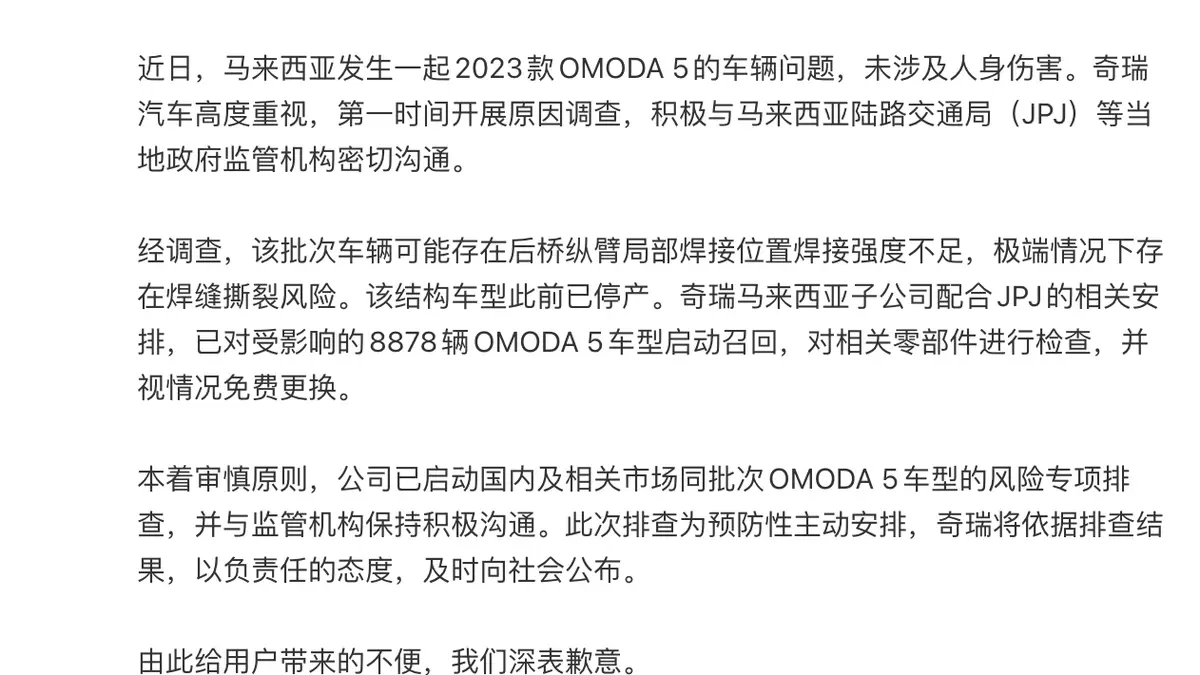
Chery has apologized and launched a recall of 8,878 OMODA 5 sport utility vehicles after a customer car in Malaysia suffered a serious failure in which the rear axle and both rear wheels detached from the body while the vehicle was being driven. The company said the affected production batches may have welds on the rear trailing arm that were not strong enough, creating a risk that the weld seam could tear in extreme conditions.
The incident happened in Johor Bahru, in southern Malaysia, and involved a 2023 model-year OMODA 5. According to reports, the rear trailing arm split while the car was moving, sending the rear axle and its two wheels away from the vehicle. No one was injured, but images of the stranded car spread quickly online, and Malaysia’s Road Transport Department (JPJ) was drawn into the case. Chery issued its apology and confirmed the recall shortly afterward.
OMODA is one of Chery’s newer passenger-car brands, aimed at younger buyers, and the OMODA 5 is one of its most visible products overseas. The model has been a spearhead for the automaker’s export strategy, sold across Southeast Asia, Latin America, the Middle East and parts of Europe. That makes the defect more than a domestic quality problem: it lands on the exact segment where Chery’s global ambitions are most concentrated.
Chery is one of China’s largest vehicle exporters, and its overseas sales have climbed steadily in recent years as the company expanded into markets where Chinese brands previously had little presence. Export growth has become a central pillar of its business, and quality control at that scale is difficult to guarantee. A single highly publicized safety failure in a foreign market can weigh on dealer confidence and consumer trust far beyond the affected units.
A suspension arm is a critical safety component. It connects the wheel assembly to the chassis and carries the forces of braking, cornering and uneven roads. If a weld on the trailing arm fails, the rear axle can separate from the car, which at highway speed could cause a loss of control. The recall language points to a localized welding problem rather than a design flaw across the whole model line, but the consequences of a bad weld in this location are severe.
Chery’s response — a public apology, a defined recall population and a stated technical cause — follows the pattern regulators and consumers now expect from global automakers. In Malaysia, the JPJ has authority over vehicle safety and recalls, and its involvement signals that the matter is being treated as a compliance issue, not just a customer-service complaint.
Recalls are common in the industry and are not by themselves evidence of a broken product. What matters is how quickly a company identifies the fault, how transparently it communicates, and whether repairs reach every affected owner. For an exporter still building its reputation abroad, the handling of these 8,878 vehicles may matter as much as the welding fix itself.
The episode also highlights the pressure facing Chinese carmakers as they scale up overseas. Rapid export growth means vehicles reach markets with different roads, climates and regulatory regimes, and defects that might once have stayed local now travel with the brand. Chery has said it will address the affected batches; owners in the region are now watching to see how smoothly that happens.