A Filmmaker's Return Home: Caring for His Father, Then His Mother
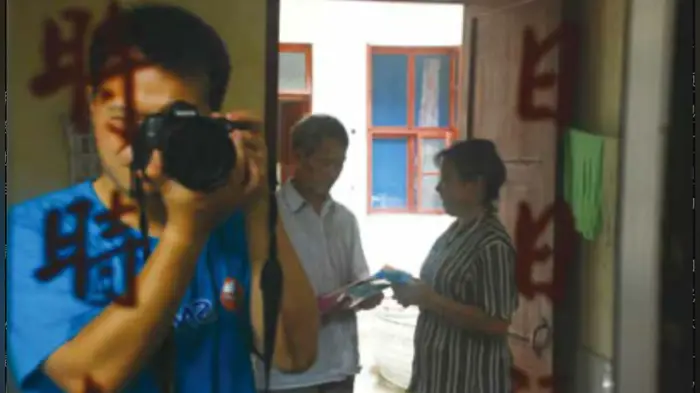
Lu Qingyi is not a household name outside China’s documentary circuit, but readers of Chinese nonfiction know him for films that turn ordinary family life into something close to poetry. His best-known work, The Four Springs, followed his parents across four New Year visits in a small town in Guizhou province in southwestern China. This month, a new book-length interview with him is drawing attention for the same reason his films did: he writes about his parents not as symbols but as specific people, and lets the reader feel the weight of that specificity.
The interview recounts a painful homecoming. In early 2023, Lu left Beijing and returned to Dushan county, in Guizhou, to take over from his older brother in caring for their seriously ill father. The day after he arrived, his father died quietly. Lu cried on his father’s body, then sat the first night of the wake alone by the brazier. From his mother’s room came a faint song, He Ri Jun Zai Lai, a popular old melody whose title asks when a loved one will return. His mother, herself bedridden and seriously ill, was singing it.
That scene is the heart of the interview. It captures something many families in China know: care for the old often falls to whoever can come home, and the return itself reshapes the person who makes it. Lu does not present himself as a saint. He describes fatigue, awkwardness and the strange intimacy of tending to a parent’s body. What he offers instead is attention, the documentary habit of watching closely without turning away.
The interview’s title quotes Lu saying that in his parents he saw the exact meaning of the phrase di lao tian huang, an idiom for something that lasts until the end of time. That is a large claim for a small-town couple, and the interview earns it by sticking to details: a fire basin, a song heard through a wall, a brother handing over a duty. The book is less a memoir of grief than a record of a son learning to see his parents as people with their own inner lives.
There is a wider cultural context. As China’s population ages, more adult children face the question of whether to return home when a parent falls ill, and many do. Yet caregiving remains largely invisible in public culture, treated as a private duty rather than a shared experience. Lu’s account joins a growing shelf of Chinese writing about illness, old age and family obligation, work that tends to be read quietly rather than debated loudly.
Lu’s method is also a rebuke to the assumption that only dramatic lives deserve documentation. His earlier films were made on tiny budgets with small cameras, and they found audiences because viewers recognized their own parents in them. The interview suggests his writing works the same way. He is not asking readers to admire him. He is asking them to look at the people sitting in the next room.
For a global reader, the appeal is not exotic. The song, the wake and the county town are local, but the situation is not: a middle-aged child returns, a parent dies sooner than expected, another parent needs care, and the child has to decide what to do next. Lu’s answer was to keep recording, turning the hardest year of his life into material that might comfort someone else’s future nights.
The interview ends where it began, with the image of grass swaying in a field. Recorded things, Lu says, can soothe the days and nights that are still to come. It is a modest promise and an old one. It may also be the most useful thing a writer can offer.