The Quiet Chinese Essay Asking What Successful Parenting Costs
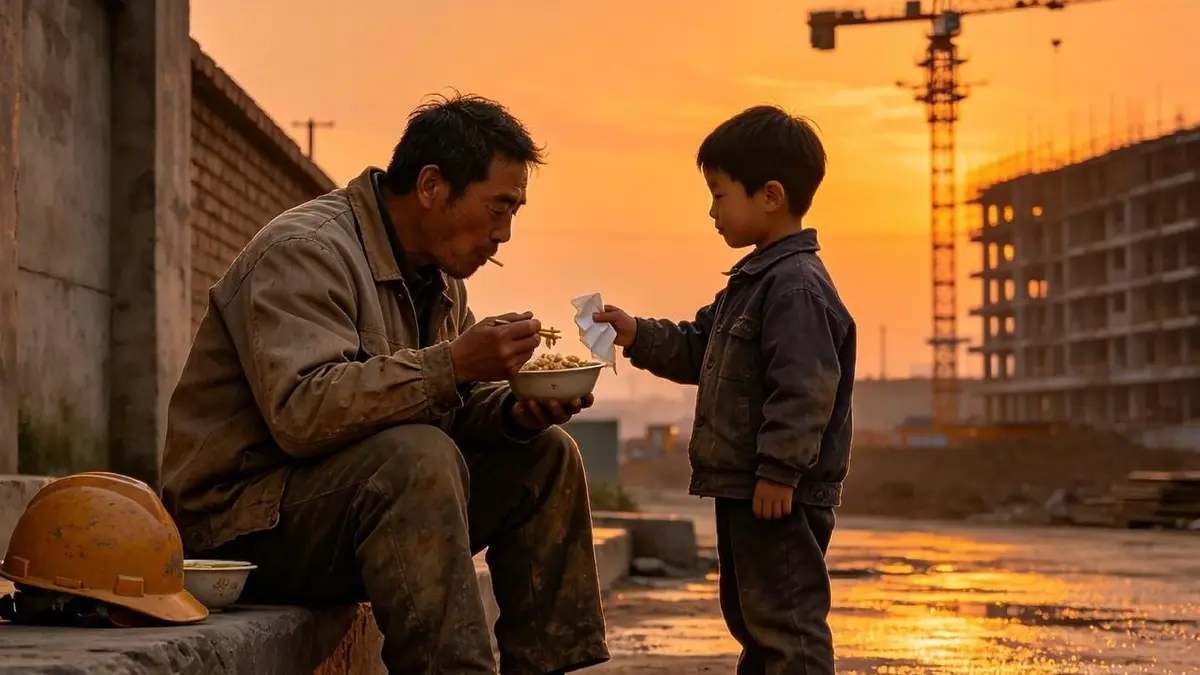
A single essay has been moving through Chinese social media, and its title is almost painfully direct: Dad, why are we so poor when we work so hard? The piece, by a writer named Li Sanqing, reportedly drew more than a hundred million reads, and its author received a fee of 50,000 yuan, a sum many commenters called proof that a single sentence can be worth its weight in gold. But the numbers are not the point.
The essay begins with a child’s question that most families recognize. A boy watches his parents leave early and come home late, sees the bills stacked on the table, and cannot square the effort with the result. The answer, in the essay, is not laziness or bad luck but the quiet, unglamorous labor that holds a household together. The writer’s real subject is the invisible scaffolding parents build so that a child can stand somewhere higher.
That theme has a darker twin, and Chinese readers have been circling it all week. Another widely shared essay describes what its author calls the most hidden form of family control: you are allowed to grow up, but not to have your own ideas. You can hold a job and pay your own rent. Yet every important decision still begins with the same question, will my parents be angry? Changing jobs requires a long explanation. Falling in love waits for approval. Even moving out arrives pre-loaded with guilt.
These two pieces are not contradictions. They are the same story told from opposite ends. One celebrates the lift that parents give. The other asks what happens when that lift becomes a leash. In a society where filial piety is not an abstraction but a lived expectation, the boundary is genuinely hard to draw. Many adult children describe feeling that their life is an exam paper waiting to be graded, where a parent’s nod means permission and a parent’s silence means doubt.
Other essays making the rounds this month touch the same nerve from different angles. One argues that the most dangerous person is not the one with few skills but the one with great ability and a low floor, the kind of success built on cutting corners. Another admits, in a confession that resonated because it is so rarely said aloud, that middle age brings a feeling nobody likes to name: envy. Scrolling a holiday feed full of other people’s glowing dinners and trips, it is easier to click like than to admit the small sour twist underneath.
The common thread is a growing willingness in Chinese writing to examine family life without varnish. Previous generations were often depicted through pure gratitude. These essays allow gratitude and grievance to coexist, and readers have responded because the mixture feels honest rather than disrespectful. The question is not whether parents sacrificed, but how a child can honor that sacrifice without surrendering the right to choose.
For readers outside China, the specifics may differ, but the tension is familiar. Every culture has its version of the parent who gives everything and the adult child who cannot quite say no. What these essays offer is a vocabulary for the in-between: love that is real, debt that is never itemized, and the slow work of becoming your own person without pretending the people who raised you do not matter.