Baidu's Apollo World Model Aims to Teach AI How to Drive
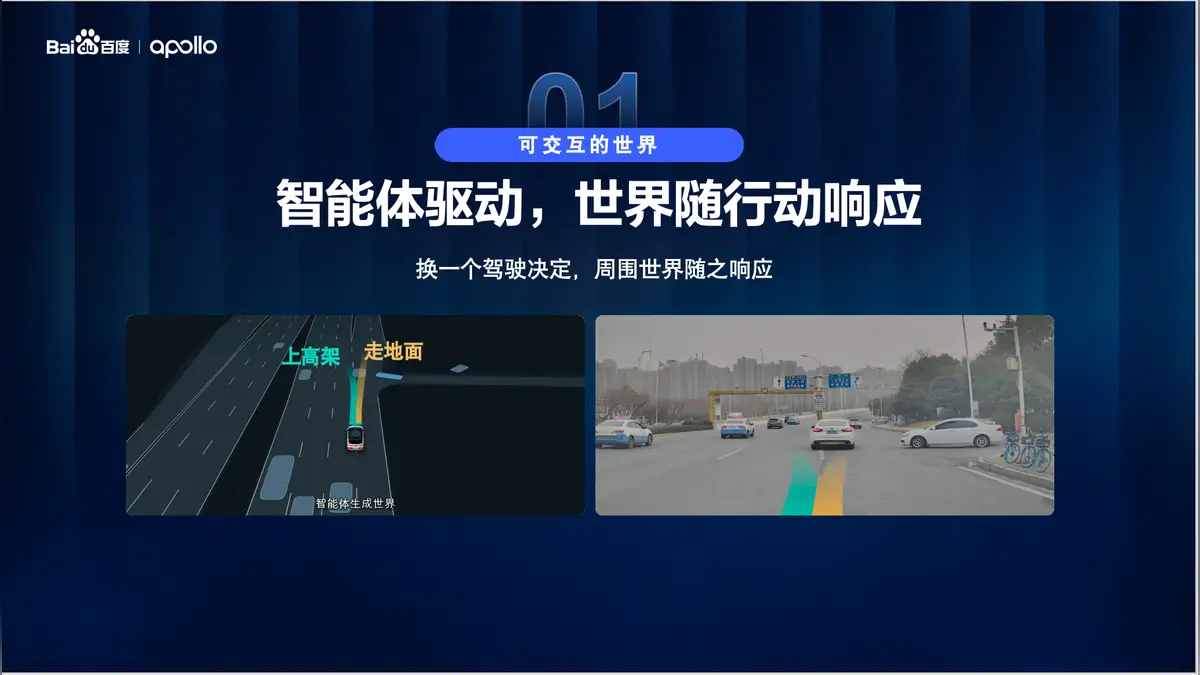
Baidu’s autonomous driving unit, Apollo, used its AI Day event in Shenzhen on November 3 to introduce Apollo World, a world model it describes as agent-driven and all-modal, built for what the company calls physical AI. The pitch is straightforward: rather than chasing photorealistic video, a world model should faithfully reproduce how the physical world behaves and how one event causes another. That distinction matters for self-driving, where a simulator that looks convincing but bends the laws of motion teaches a car the wrong lessons.
Apollo framed the release around a self-declared rubric it calls the 2+3 standard for judging world models. In the company’s telling, the first pair covers what a model must understand about physics and causality, while the remaining three concern how those capabilities are put to work in an autonomous system. Baidu did not publish benchmark numbers alongside the announcement, so the standard reads more as a statement of intent than a scoreboard for comparing models across the industry.
The more concrete claim is deployment. Apollo says the model is already being used in the global testing and validation of Apollo Go, its robotaxi service, as the company pushes to scale driverless rides beyond China. Using a world model for validation means generating rare and dangerous scenarios on demand, such as an unexpected pedestrian or a vehicle cutting across lanes, instead of waiting for them to occur on public roads. That is the practical argument for simulation: the long tail of edge cases is where autonomous driving programs tend to stall.
The announcement also fits a broader pattern in Chinese AI. Baidu’s IDG chief architect and technical committee figures presented the model as part of a shift toward agents that act in simulated environments, learning from consequences rather than from static datasets. The phrase AI teaching AI to drive captures the ambition: one model generates the world and its complications, while another learns to respond.
For Baidu, the stakes are commercial as much as technical. Apollo Go is among the few robotaxi operations running without a safety driver in Chinese cities, and expansion abroad brings new road rules, weather and driving habits that are expensive to learn on real streets. A world model that can be tuned to a new market before a single car arrives could shorten that process.
Global readers should treat the 2+3 framing with some caution until independent evaluations exist. World models are fashionable across the industry, from robot training to video generation, and every company is currently writing its own definition of what counts as a good one. Baidu’s contribution is less a new benchmark than a claim that causal fidelity, not visual polish, is the right target.
The signal to watch is whether Apollo Go’s overseas testing produces measurable gains, such as fewer interventions per kilometre or faster approval in new cities, that Baidu attributes to simulation. If the model’s scenarios prove predictive of real road behaviour, other robotaxi operators will face pressure to show what their own simulators can do.