China Built 89,000 Highway Chargers. The Queues Didn't Move.
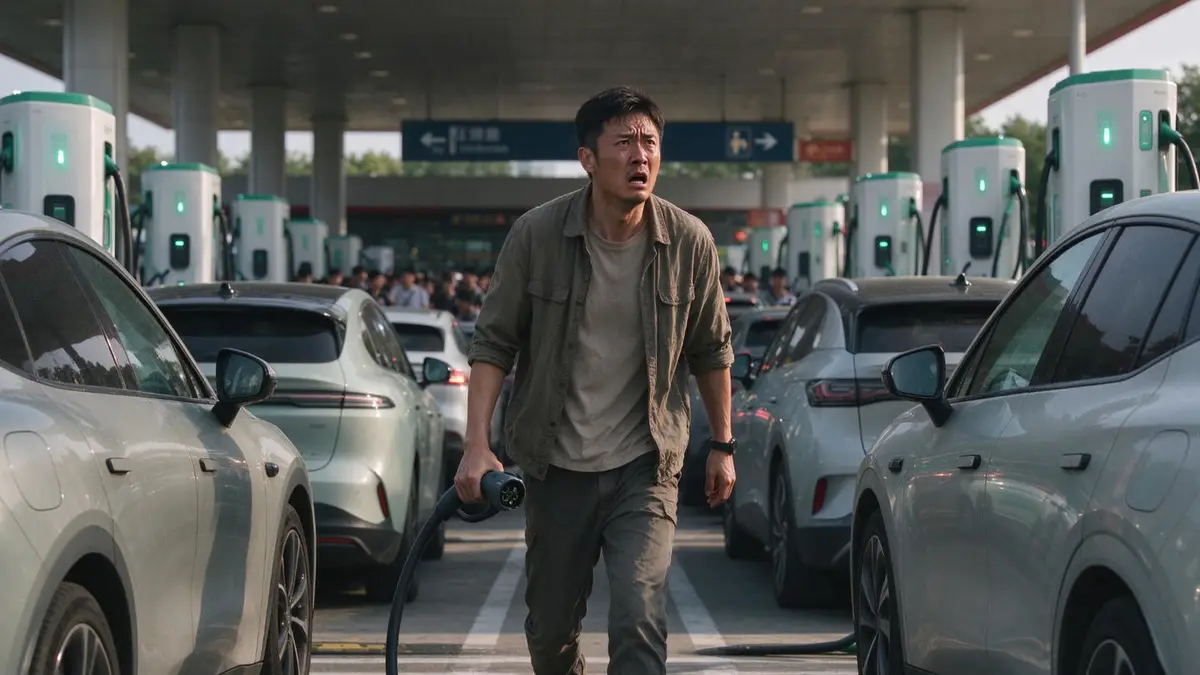
Every October, millions of Chinese families pile into their electric cars and head for the highways at the same time. Every October, they end up parked in a charging queue instead. This year was no different, despite one of the most aggressive infrastructure pushes the country has ever attempted.
The numbers look impressive on paper. China’s highway service areas have now accumulated roughly 89,000 charging facilities, according to the transport ministry, and the ministry added 11,000 large-power chargers in the first eight months of 2026 alone — a volume equal to everything built before it. Charging equipment now covers essentially every service area on the national expressway network. On the surface, it reads like a solved problem.
Then the holiday arrives and the arithmetic collapses. On the first day of the National Day break, highway charging demand hit record levels, and chargers that sit idle most of the year suddenly face a wall of cars arriving within the same few hours. A charger rated for one car at a time cannot become two because the calendar says so. Drivers reported waits measured in hours, with some queuing not just for a plug but for the right to hold a place in line.
The core problem is not the total number of chargers. It is their distribution in time. Outside a handful of peak travel windows, many highway charging sites run well below capacity. Building for the worst hour of the worst day of the year would mean leaving enormous amounts of expensive equipment idle for the other 350 days. Operators, who must recover their investment, have little appetite for that. So capacity is sized somewhere between average and peak, and the peak is brutal.
There is also a physics problem. Charging speeds fall sharply as a battery fills, so the last portion of a session takes disproportionately long. A driver who insists on reaching 100 percent can occupy a charger for far longer than one who stops at 80 percent. Multiply that behaviour across a crowded service area and the queue compounds. Some operators have tried idle fees and state-of-charge caps, but enforcement is awkward and drivers, reasonably, want a full battery before the next long stretch.
Battery swapping offers one escape route. Swap stations can turn a car around in minutes and, crucially, they can be stocked during off-peak hours, shifting the energy demand away from the moment of use. A few automakers have built swap corridors along major routes, and the model performs well during holiday surges. But swap networks only serve cars from brands that designed for them, leaving most drivers out.
Another answer is behavioural. Chinese travel demand is extraordinarily concentrated: the same days, the same highways, the same exits. Spreading departures by even a few hours would flatten the curve more effectively than any single engineering fix. Some provincial authorities have experimented with staggered toll discounts and real-time queue information pushed to navigation apps, letting drivers choose a quieter service area further along. Early results suggest many will divert if they know what awaits them.
The deeper lesson is that charging infrastructure is not a construction problem but an operations problem. China has proven it can build at extraordinary speed. What remains is the harder task of making a system behave well when everyone shows up at once — pricing, information, swapping and flexibility, not just more steel and cable.