London Souvenir, Zhengzhou Campus: The Fake Fridge Magnet Problem
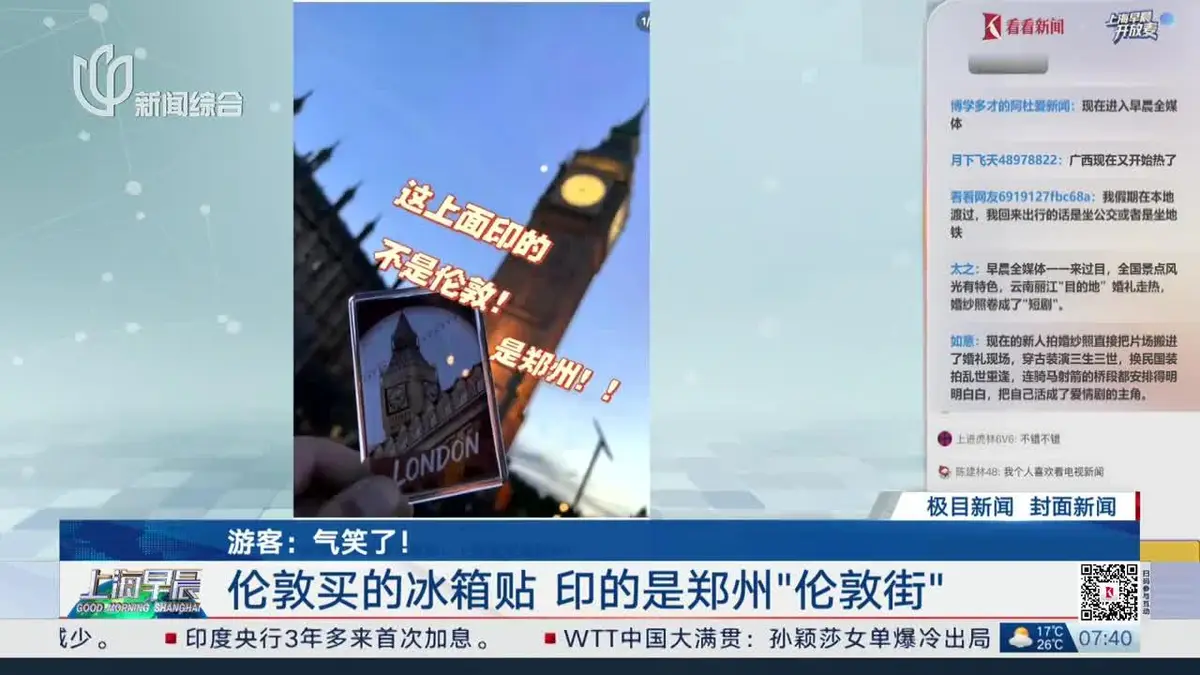
A Chinese traveler recently bought a fridge magnet in London, carried it to the real Big Ben, and tried to line up the shot. The composition never matched. Back home, a closer look revealed why: the magnet did not show Big Ben at all. It showed London Street, a themed campus quarter at Sias University in Zhengzhou, a city in central China’s Henan province. The traveler had flown thousands of miles to bring home a photograph of a domestic university.
The story did not end there. Another visitor paid five euros for an Eiffel Tower poster by the Seine in Paris. Only when framing it at home did the buyer notice two high-rise apartment blocks beside the tower. As an architecture professional, the buyer quickly identified them as buildings in Tiandu City, a residential development in Hangzhou, eastern China. A Paris landmark, printed beside a Hangzhou housing estate, sold on a Paris riverbank.
The pattern is not new, but it is getting harder to ignore. Souvenir printing is a global business built on stock imagery, and the people assembling magnets, mugs and postcards rarely check what the picture actually depicts. A generic image labeled London, Paris or Rome sells just as well as an accurate one, and it costs the same to print. The trouble only surfaces when a buyer stands in front of the real thing and compares.
What makes these cases interesting is the geography. Both fake images came from China: a university campus in Zhengzhou and a residential district in Hangzhou. Tiandu City is a long-running imitation of Paris, complete with its own Eiffel Tower replica, built as a real-estate concept. Sias University’s London Street copies British brick facades and street furniture. These places exist precisely because European scenery sells at home. Now that scenery has traveled abroad and returned as counterfeit merchandise.
Chinese social media users treated the discovery as comedy rather than outrage. The jokes wrote themselves: a full-circle moment where Chinese construction imitates Europe, then gets photographed and sold back to Europeans and Chinese tourists alike. Commenters compared notes on similar finds, from Rome postcards showing the wrong fountain to Swiss magnets with mountains that belong to another continent. The tone was affectionate, the way people laugh at a cheap magic trick.
The practical lesson for travelers is simple. If a souvenir claims to show a landmark, compare it with the landmark before paying, especially at stalls near major attractions where turnover is fast and nobody expects a refund. Buy from museum shops or established local makers when accuracy matters. If the point is only a small, cheap memento, then the joke may be worth the price.
For the destinations, there is a quieter message. A magnet is a tiny ambassador. When it shows the wrong skyline, the buyer remembers the mistake longer than the trip. Some cities have started policing souvenir authenticity, but enforcement is difficult across international supply chains that treat landmarks as interchangeable clip art.
The two travelers now own something arguably more memorable than what they intended. One has a Zhengzhou campus on her fridge, standing in for Big Ben. The other has Hangzhou apartments beside the Eiffel Tower. Neither is what they paid for, and both are stories they will tell for years.