The Star Who Lost Her Own Name: China's Weibo ID Problem
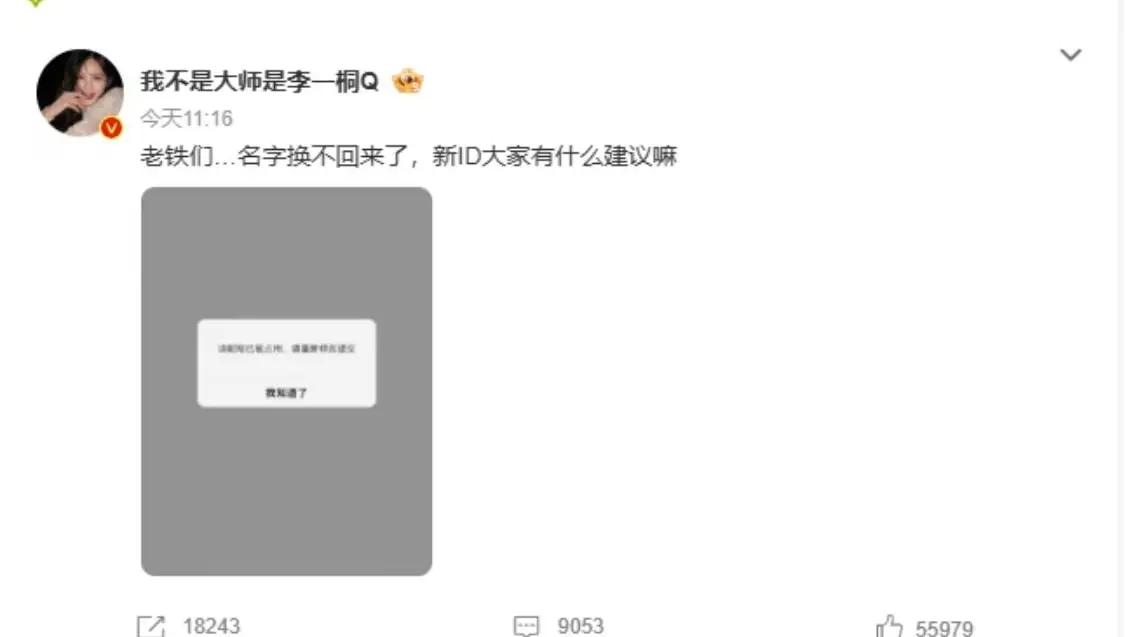
Chinese actress Li Yitong has a problem most people would never think to worry about: she can no longer use her own name online. On October 8, the 35-year-old posted a plea on Weibo, China’s dominant microblogging platform, asking followers for suggestions because her attempt to reclaim her old handle was rejected by the system. The name, she explained, was already occupied.
The trouble began in late September, when Li and her co-star Li Xian changed their Weibo nicknames in unison to promote their new mystery drama, I Am Not a Master. Both swapped their handles and profile pictures to match their on-screen characters, a tactic Chinese production teams increasingly use to blur the line between fiction and promotion. It worked as marketing. Then the show ended, and Li tried to change back.
That is when the platform’s rules caught up with her. Weibo handles are first come, first served, and once a name is released, anyone can claim it. Within days, her original ID had been seized by another user. That account has since been suspended, but the name itself remains locked, meaning Li cannot simply take it back. She now faces the odd predicament of being a public figure who no longer owns the digital version of her own name.
Li is far from a newcomer. Born in Jinan, Shandong province, she trained as a dancer at Beijing Dance Academy before moving into acting. She built a following through costume dramas and modern romance series, becoming one of the more recognizable faces in mainland Chinese television without quite reaching the top tier of the industry. For actors at her level, a stable social media identity is not vanity; it is infrastructure, the anchor that lets fans, brands and streaming platforms find them.
Her public appeal for help drew a mix of sympathy and amusement. Some fans offered elaborate alternatives. Others pointed out the obvious irony: an actress who spent weeks pretending to be someone else for a show discovered that the internet had moved on without her. The episode says something about how celebrity works in China now, where promotion is not a press tour but an all-in performance across platforms, and where a marketing stunt can quietly cost you your own name.
Weibo’s naming system has caused friction before. Unlike verified accounts on some Western platforms, handles and display names are not permanently reserved for the famous, and impersonation is handled after the fact rather than prevented. That makes the platform fast and open, but also chaotic during coordinated campaigns, when thousands of users may be chasing the same trending keywords.
For Li, the practical fix is simple and slightly humiliating. She will pick a new handle, probably one with a distinguishing letter or number, and carry on. The old ID, the one her fans typed for years, will belong to whoever got there first.
It is a small story about a small inconvenience, but it lands in a moment when Chinese entertainment is obsessed with online presence, follower counts and the mechanics of attention. Li Yitong wanted a memorable role. Instead she got a lesson in how fragile a name can be when a platform owns it.