A Qing Dynasty Temple Tower That Cracked but Would Not Fall
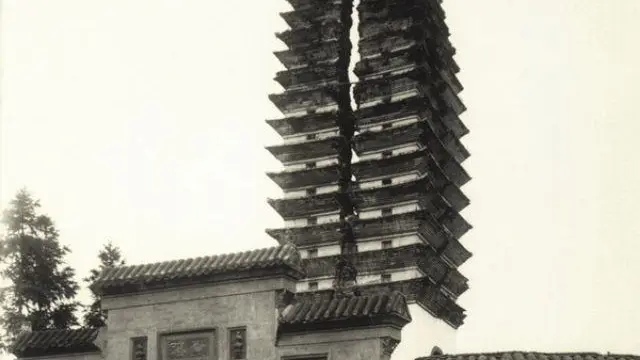
Among the thousands of old photographs that circulate in Chinese online history forums, one keeps returning: a square brick pagoda in Pengzhou, Sichuan, photographed around 1911 by an American named Luther Knight. The tower is visibly split, its upper storeys leaning apart, and yet it stands. Chinese readers call it the “cracked tower that did not fall.”
The pagoda belongs to Longxing Temple, founded in the Eastern Jin dynasty in 337 and known by several names before the Tang emperor Xuanzong gave it its current one in 718. The temple was suppressed in 845, rebuilt in 848 by a monk named Yuzhi, and the brick tower went up around then. It is a fourteen-sided, seventeen-storey structure of the type Chinese architectural historians call dense-eave, with a bronze bell at every one of its sixty-eight corners. Knight, who lived from 1879 to 1913, was in Sichuan with a camera at a moment when few foreigners were.
The photograph matters because it captures a building in the middle of failing. Brick towers of this kind were built without steel, relying on the weight and friction of carefully cut masonry. When the ground moves, or the foundation settles unevenly, the structure can split along a vertical seam and still hold, each half propping the other up. Engineers who study historic masonry call the effect a stable ruin: the building has found a new equilibrium, just not the one its builders intended.
The question underneath the photograph is the one Chinese heritage fans argue about constantly: whether to visit old sites early, before repair, development or simple neglect changes them. The phrase “visit antiquities while you still can” is a running joke in these circles, and it is only half a joke. A temple that survived a ninth-century purge and a twentieth-century earthquake can still be lost to a road project, a clumsy restoration or a decade of no one looking.
The Longxing Temple tower has been repaired more than once, and visitors today see a stabilised structure rather than the wounded one in Knight’s negative. That is the ordinary outcome, and it is not a scandal. The harder problem is the opposite case: the hundreds of smaller, less photogenic sites that no one has photographed, catalogued or funded, and which disappear without a before picture.
Knight himself is part of the story. He died in 1913, and his glass plates sat in storage for decades before being printed. A building’s survival and its record’s survival turn out to be separate accidents. The tower stood because its masonry held. The image survived because someone kept a box.
For a global reader, the appeal is not exotic. Every country with old buildings faces the same trade-off between freezing a structure and letting it age, and every country has photographs that show what was lost. What makes the Chinese case vivid is scale: a continuous building tradition of more than a thousand years, a century of upheaval, and now a large amateur audience that treats old photographs as evidence.
The next thing to watch is quieter than a collapse. Watch how many of these lesser-known sites get a public record — a survey, a photograph, a listing — before anyone needs to argue about whether to save them.