A Car Can Be Built by Many Firms, but a Brand Must Grow Its Own System
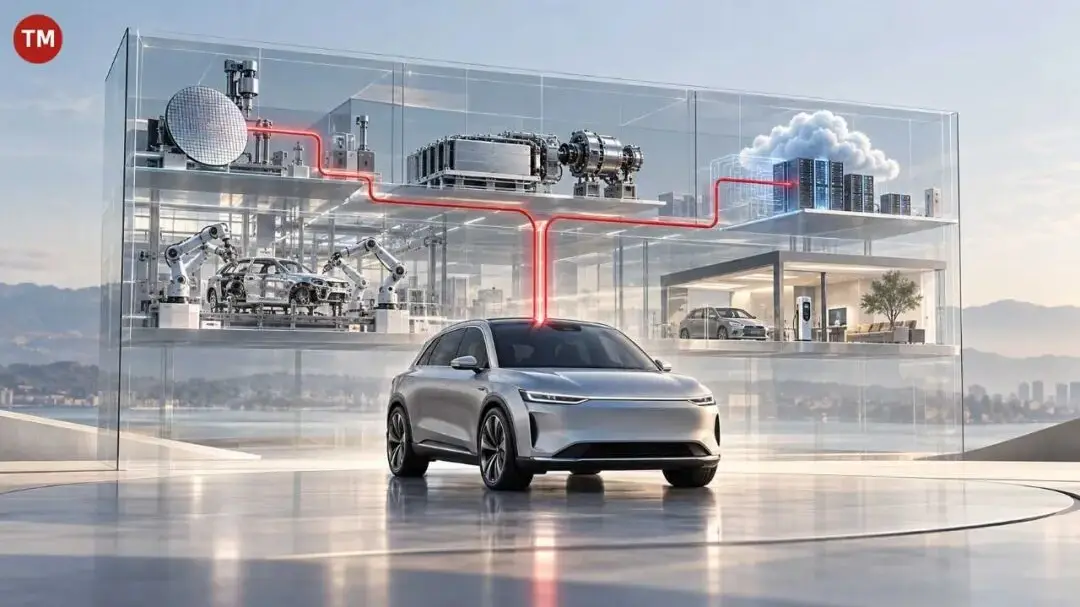
For most of automotive history, the answer to “who builds this car?” was simple: one company, one badge, one factory. That assumption is quietly dissolving in China. A new essay from the WeChat account 战魔田默, published under the auto and mobility vertical, argues that today’s smart electric vehicle is less a single product than a system — one that runs on a whole-car platform, software, chips, data, sales channels and after-sales service working together. When so many hands touch one machine, the interesting question is no longer who assembles it. It is what makes the brand grow.
The piece uses the changing cooperation model behind AITO, the premium electric brand associated with Seres and Huawei, as its starting point. On the surface, the shift looks like two companies rearranging who does what. Look deeper, the author writes, and it touches something bigger: as partners get stronger, a product can reach the market faster and arrive with more capability than any single firm could muster alone. But that same strength raises a risk. If every compelling feature carries someone else’s signature, what does the badge on the hood still stand for?
China’s EV market has spent the past decade proving that speed and integration win. New models now launch in months rather than years, over-the-air updates rewrite a car’s behavior after purchase, and driver-assistance features improve through data collected from thousands of vehicles on real roads. None of that is possible inside one traditional silo. Suppliers of batteries, chips and software are no longer vendors in the old sense; they are co-authors of the driving experience.
The essay’s answer is that a brand cannot be outsourced, only built. A system can be assembled from partners, but the meaning of the system — why a buyer chooses this car over a nearly identical one — has to come from somewhere internal. That means owning the parts customers actually feel: the interface they touch every day, the way the car behaves when something goes wrong, the consistency of service after the sale, the promise that an update will not strand them. Strong partners can supply hardware and code. They cannot supply trust.
This is where the Chinese industry is entering unfamiliar territory. Legacy automakers grew brands over decades of engines and dealerships. The new generation must grow them in public, at software speed, while leaning on companies that may also supply their rivals. The same chip vendor, the same battery maker, the same mapping and data provider can sit inside several competing vehicles. Differentiation has to live above that shared layer.
The author stops short of predicting winners, and wisely so. But the framing is useful for anyone watching the sector: the competition ahead may be less about who can bundle the best partners and more about who can turn that bundle into a coherent identity. A car can be completed by many enterprises. A brand has to complete itself.
For global readers, the lesson travels beyond China. As software-defined vehicles spread, every automaker faces the same tension between openness and identity. The companies that resolve it will be the ones whose customers can still say, plainly, what the badge means.