China's Golden Desert Forest Has a 20-Day Window
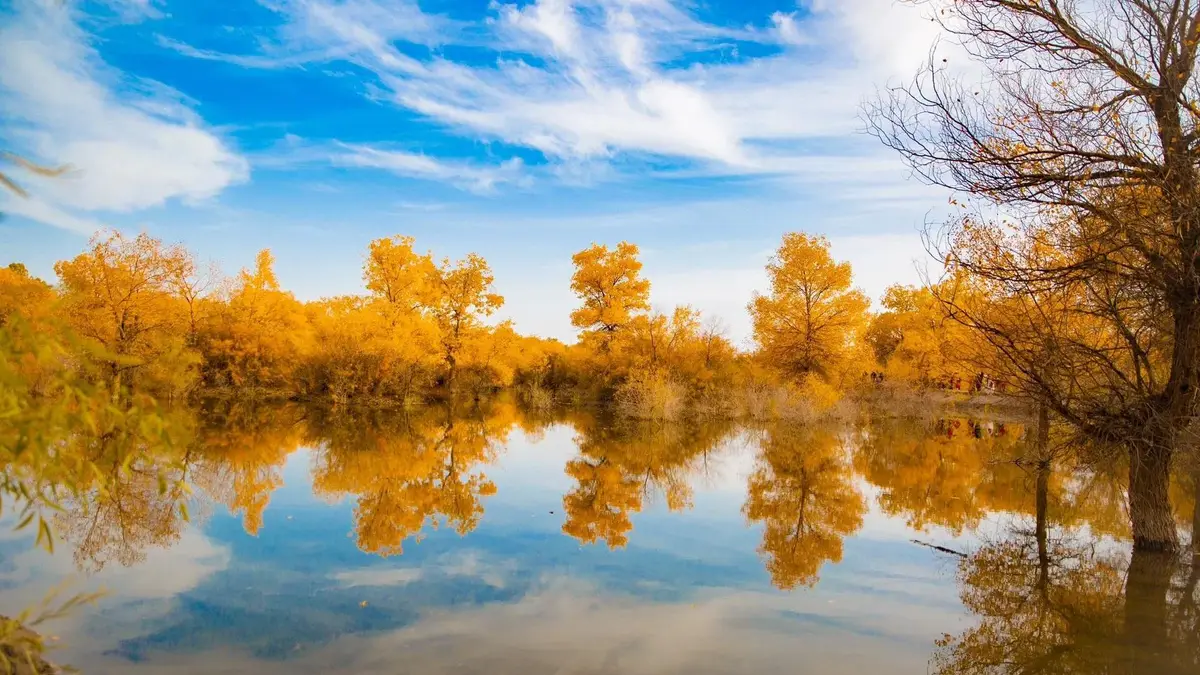
Every autumn, a remote corner of Inner Mongolia becomes one of China’s most photographed landscapes — and then it disappears for another year. The Ejina poplar forest, a belt of desert trees covering roughly 100,000 hectares in the far west of the region, turns gold for only about 20 days, usually in the first half of October. This year, cooler weather arrived on a favorable schedule, and forecasters point to mid-October as the golden window.
The trees are Euphrates poplars, known in Chinese as huyang. They are famous for a saying that has become a tourism slogan: they live a thousand years without dying, stand a thousand years after death, and lie a thousand years without rotting. In the desert, that toughness is not marketing. The trees survive on scarce groundwater, anchoring sand and sheltering the oasis around them. When the chlorophyll drains from their small, diamond-shaped leaves, the whole forest turns a uniform, almost metallic gold.
Ejina sits in the Alxa League, a sparsely populated area of desert and dry grassland near the border with Mongolia. Getting there is part of the story. Most visitors fly to a small regional airport or take long overnight trains and then drive. The reward is a landscape of sand dunes, dead trunks and living trees that photographers compare to a natural gallery.
Within the scenic area, visitors move between numbered bridges and viewpoints, from the first bridge to the eighth. Each has a different character: some look over water where trees double in reflection, others face open dunes. Sunrise and sunset are the busiest hours, when low light makes the gold glow and the sand turn amber. Crowds gather early for the best positions, and shuttle buses fill quickly.
Because the season is so short, accommodation in the county town is limited and prices spike. Travelers who have made the trip advise booking rooms weeks ahead, or staying in nearby towns and driving in. Layered clothing is essential: desert days can be warm while nights drop close to freezing. Wind and dust are common, so lens cloths and masks help.
For global visitors, Ejina is a reminder that China’s travel map is far larger than its famous cities. The same autumn weeks also bring pink muhly grass into bloom in parks around Suzhou, and cooler weather across the north, but the poplar forest is the most fleeting. Miss it, and the next chance is a year away.
If you go, plan around the light rather than the clock. Arrive before dawn for the quietest hours, keep a full day for the outer bridges, and leave time for the desert itself. The gold does not wait, and that is exactly why people go.