China's Holiday Souvenirs Are All the Same Three Things
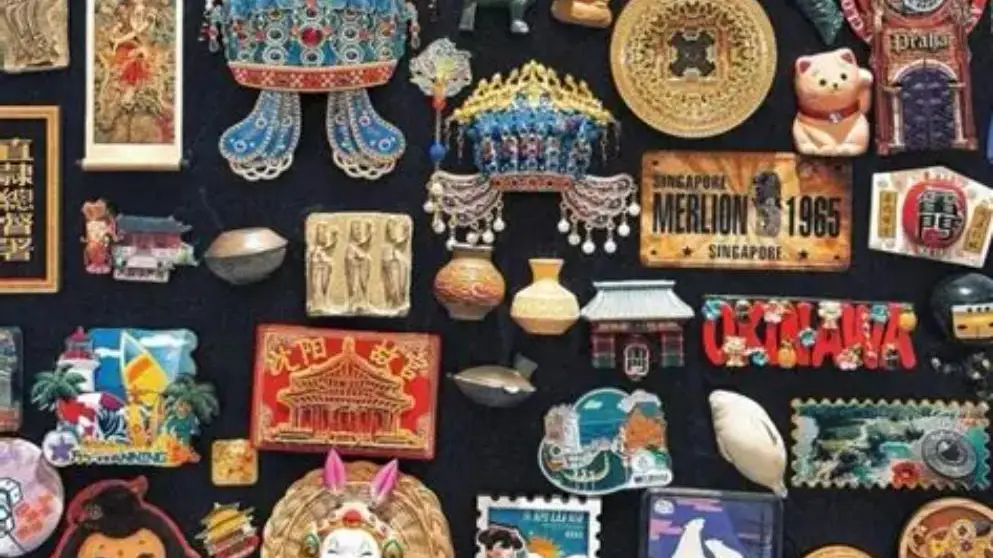
A traveler browsing the old town of Kashgar in far western Xinjiang picks up a fridge magnet marked as a local limited edition. Back at the hotel, a quick search on an e-commerce platform turns up the identical item for nine yuan and ninety fen, shipping included. Worse still, a near-identical magnet appears with the place name changed from Kashgar to Hotan, right down to the same typeface.
The complaint posted online drew a crowd of travelers with the same experience. One remembered haggling over souvenirs on West Street in Yangshuo, a well-known tourist strip in Guangxi, only to find the same goods in the next shop and then online for a fraction of the price. The pattern has become so familiar that Chinese travelers now joke about a standard souvenir trio: the fridge magnet, the canvas tote bag and the keychain.
Souvenir stalls from the ancient lanes of Lijiang in Yunnan to the lakeside walks of Hangzhou are stocked with what looks like the same catalog. Swap the city name, keep the artwork, adjust the color slightly, and the product is ready for a new market. The magnets are cheap to produce and light to ship, which makes them an easy bet for vendors who cannot predict what will sell.
The result is a strange kind of sameness across a country with enormous regional variety. China has thousands of years of craft traditions, from Suzhou embroidery to Jingdezhen ceramics to the woodblock prints of the south. Yet many visitors leave with a piece of printed plastic that could have come from anywhere.
Travelers say the problem is not that mass-produced items exist. It is that they crowd out everything else. A shopkeeper who stocks a locally designed postcard or a hand-thrown teacup has to compete with a stall selling identical magnets at a fifth of the price. Buyers who want something meaningful often give up and buy nothing at all.
Some destinations are trying to break the loop. Museums have moved aggressively into merchandise, turning paintings and bronzes into notebooks, scarves and figurines with a recognizable identity. Smaller studios are experimenting with limited runs tied to a specific festival or a local landmark. The economics are harder, but the margins can be better when a product cannot be instantly copied.
The copycat magnet story also says something about how domestic tourism has grown. Travel within China is now routine for hundreds of millions of people, and the market rewards speed and volume. But as travelers take more trips, they start to notice what is missing. The fridge magnet on the door at home is supposed to hold a memory. If the same one hangs on a door in another province, the memory fades.
For now, the joke travels faster than the fix. Travelers share photos of identical souvenirs from cities a thousand kilometers apart, and the comments fill with recognition. The question many are asking is simple: if a place is worth visiting, why does its souvenir shelf look exactly like the last one?