Hengdian Bets $33 Million on AI to Remake China's Film Capital
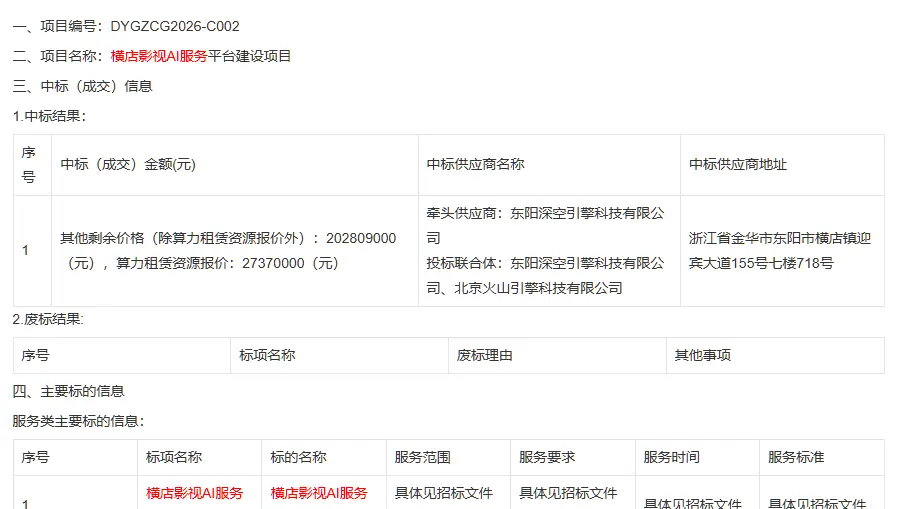
Hengdian, the sprawling studio town in Zhejiang province that has stood in for imperial palaces, Republican-era Shanghai and countless fictional worlds, is making a bet on artificial intelligence. A consortium led by Dongyang Shenkong Engine, a ByteDance-affiliated company, together with ByteDance’s cloud unit Volcano Engine, has won a contract worth 235 million yuan — roughly 33 million US dollars — to build an AI service platform for the film industry, according to a procurement notice published by the Dongyang branch of the Jinhua public resources trading center.
The tender process began in July, and the award notice landed this week. Under the deal, the partners are expected to build tools that let productions generate and manipulate footage, manage visual effects and speed up post-production — the kind of work that has traditionally consumed the most time and money on a Chinese set.
The timing is not accidental. Hengdian’s weekly production bulletins, which track which crews are filming, tell a story of a cooling market. Over the fourteen weeks from late June to late September of this year, the number of active productions has thinned, a slowdown that mirrors broader caution in China’s film and streaming industries. Studios are making fewer shows, and the ones they do make are under pressure to cost less.
For Hengdian, AI is both a defensive move and an opportunity. The town built its reputation on scale: backlots, water towns, palace gates and thousands of extras who can be summoned at short notice. But scale is expensive to maintain when productions become scarce. If AI can replace some crowd scenes, some set extensions and some post-production labor, the base can keep attracting crews that might otherwise shoot elsewhere or not at all.
ByteDance’s involvement is telling. The company has been pushing its generative video tools into professional markets, and film production is one of the most demanding testing grounds available. A platform built for Hengdian would generate a steady stream of real-world use cases, feedback and footage — valuable data for improving the models. Volcano Engine, meanwhile, gets a flagship customer for its cloud and computing services.
The town is not alone in chasing this shift. Earlier this year, a Chinese zombie horror film backed heavily by AI-assisted effects crossed 42 million dollars at the box office, proof that audiences will accept synthetic imagery when the story works. Other Chinese studios are experimenting with AI storyboarding, de-aging and voice work. Streaming platforms have begun quietly testing AI-generated background shots in dramas.
Still, the announcement raises familiar questions. China’s film workers have watched the growth of generative video with unease, particularly the thousands of Hengdian extras whose livelihoods depend on crowds being real. Industry veterans argue that AI can handle spectacle but struggles with the small human moments that carry a scene. The most likely outcome is neither replacement nor business as usual, but a reallocation of budgets: fewer people on set, more spending on software and computing.
What happens in Hengdian will be watched closely far beyond Zhejiang. If a 33-million-dollar AI platform can measurably cut production costs in the world’s busiest film town, it will become a template for studios everywhere. If it cannot, it will be an expensive lesson in what the technology still cannot do.