I'd Pick Myself Against Anyone Except Juninho, Says Sneijder
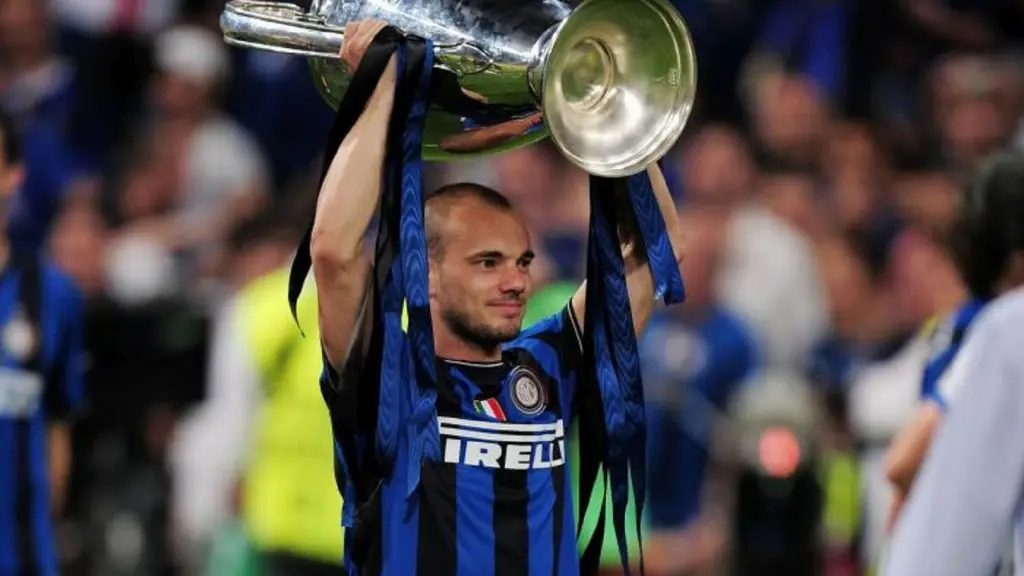
Wesley Sneijder spent his career striking a ball better than almost anyone of his generation, so when an Italian newspaper handed him a list of famous free-kick takers and asked him to pick winners, his answers surprised nobody — except for one.
The former Netherlands and Inter Milan midfielder took part in a free-kick challenge organised by La Gazzetta dello Sport at a sports festival in Italy. The format was simple: two names, one question, who is better? Sneijder, now 42, answered with the confidence of a man who once scored from set pieces in a Champions League final.
Against David Beckham, the英格兰 icon whose bending deliveries became a global trademark, he chose himself. Against Andrea Pirlo, the deep-lying playmaker who dictated Italy’s rhythm for a decade, he chose himself. Against Francesco Totti, Alessandro Del Piero, Roberto Carlos and Sinisa Mihajlovic — one of the most feared dead-ball specialists of the 1990s — the answer was the same every time: me.
There was only one exception. Asked to compare himself with Juninho Pernambucano, the Brazilian who scored an extraordinary number of free kicks for Lyon and is widely regarded as the finest set-piece taker the game has seen, Sneijder conceded immediately. Juninho, he said, was better. For a player known for his blunt self-belief, the admission carried weight.
Sneijder’s own record gives him the right to talk. He was the creative engine of the Inter side that won the treble under Jose Mourinho in 2010, and he helped the Netherlands reach the 2010 World Cup final in South Africa. His left foot produced goals from distance, whipped crosses and free kicks that frequently decided tight matches. In 2019 he retired after a career that also took him to Real Madrid, Ajax and Galatasaray.
The free-kick debate is one of football’s oldest arguments, and it rarely produces agreement. Fans in England will argue for Beckham’s accuracy and the sheer volume of goals he created. Italians will point to Pirlo’s elegance or Mihajlovic’s ferocious left foot, which produced a hat-trick of free kicks in a single Serie A match in 1998. Brazilians will mention Roberto Carlos and the impossible curve he applied to a ball against France in 1997.
What makes the discussion durable is that free kicks sit at the intersection of technique, nerve and theatre. A penalty is a duel with the goalkeeper. A free kick is a duel with physics, with the wall, and with the memory of every great strike that came before. Players who master it become folk heroes in a way that few other specialists do.
Sneijder’s answers, delivered in a light-hearted festival setting rather than a press conference, reflect something familiar about elite athletes: the unshakeable conviction that on their best day, nobody is better. That belief is often what separates those who reach the top from those who merely come close. It also makes for good entertainment when a legend is asked to rank himself against his peers.
For supporters in Asia who grew up watching Serie A broadcasts late at night, the names on that list — Totti, Del Piero, Pirlo, Mihajlovic — carry a particular nostalgia. Italian football was the first European league many fans across the region followed closely, and the free-kick specialists of that era remain vivid. Sneijder’s verdict will not settle anything, but it will give those fans one more reason to argue.