Japan's Small Businesses Are Folding at a 13-Year High
Japan’s small-business backbone is cracking. On October 8, Tokyo Shokō Research, a private credit research firm that has tracked corporate failures in Japan since 1912, reported that 5,373 companies with liabilities of at least 10 million yen (roughly 65,000 US dollars) went bankrupt between April and September of fiscal 2026. That is a 13-year high, up 3.8 percent from the same period a year earlier. Total liabilities tied to those failures reached 856.17 billion yen, a jump of 23.5 percent.
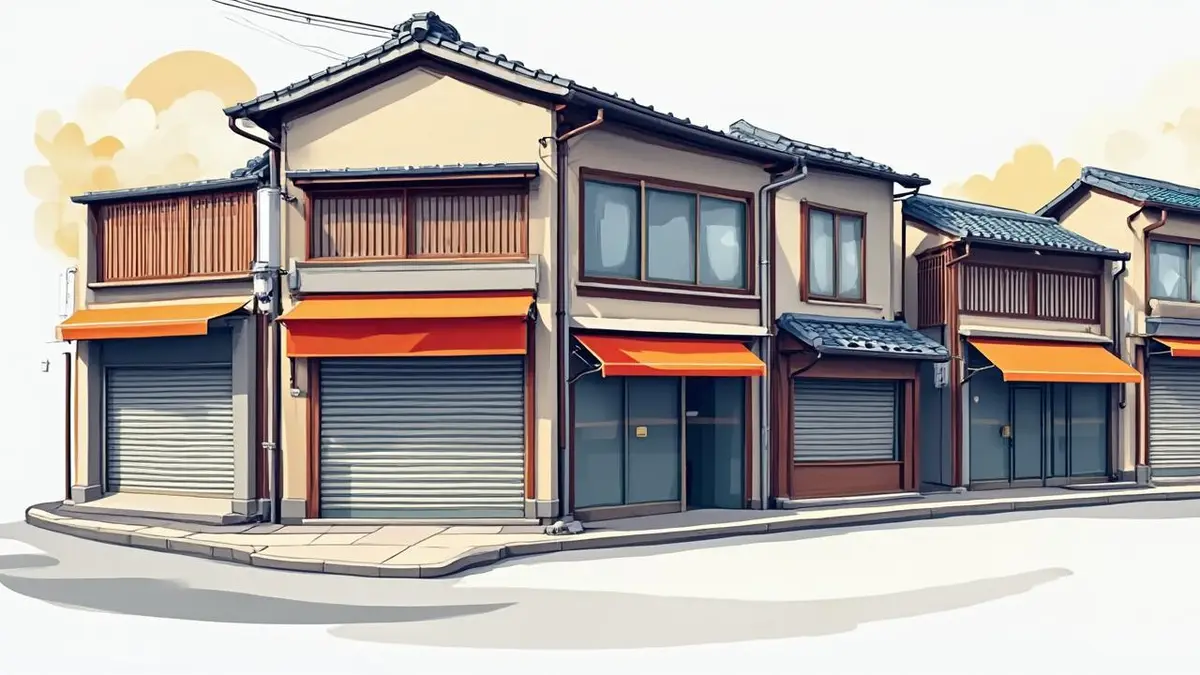
The numbers reveal something more troubling than the headline count. Companies with debts under 100 million yen made up 77 percent of the failures, and businesses employing fewer than ten people accounted for 90.6 percent. These are the ramen shops, family-run hardware stores, small machine-parts workshops and local construction firms that give Japanese neighborhoods their texture. They are also the most fragile when borrowing costs rise.
Interest rates sit at the center of the story. After years of holding rates near or below zero, the Bank of Japan has been gradually lifting them as inflation took hold. For a large manufacturer with cash reserves, a modest rate increase is a line item. For a ten-person company that has rolled over the same bank loan for a decade, it can be the difference between surviving and closing. Small firms also face higher fuel, energy and raw-material costs, and many have been unable to pass those costs on to customers because they lack pricing power.
Labor shortages add another layer. Japan’s working-age population has been shrinking for years, and small businesses in regional towns struggle to hire. When an owner retires without a successor, the only option is often liquidation. Even some of the country’s celebrated long-established firms, the so-called shinise that have operated for a century or more, have not been spared: 112 such companies failed in the first eight months of 2026 alone.
There is a global lesson here that goes beyond Japan. For decades, ultra-low interest rates kept marginal businesses alive by making debt cheap. When rates normalize, the weakest borrowers are the first to fail, even if the broader economy looks stable. Analysts in Europe and the United States are watching Japan’s experience closely, because many economies are emerging from a similar era of easy money.
For ordinary Japanese households, the effect is felt in everyday ways. A favorite bakery closes. A repair shop that fixed watches for three generations shuts its doors. Employees who spent their careers at a small firm must look for work later in life, often with skills that do not transfer easily.
The wave may not crest soon. If rates continue to climb and demand stays soft, more small firms will face the same arithmetic. Some economists argue this is a necessary shakeout that will push capital and workers toward more productive companies. Others warn that the social cost, measured in empty storefronts and displaced workers, will be paid for years.
Either way, the first half of fiscal 2026 has already written a record that few in Japan expected to see again. The country’s small businesses are not a footnote to its economy. They are most of it, and they are under strain.