Hainan Extends On-Completion Home Sales, and Builders Are Watching
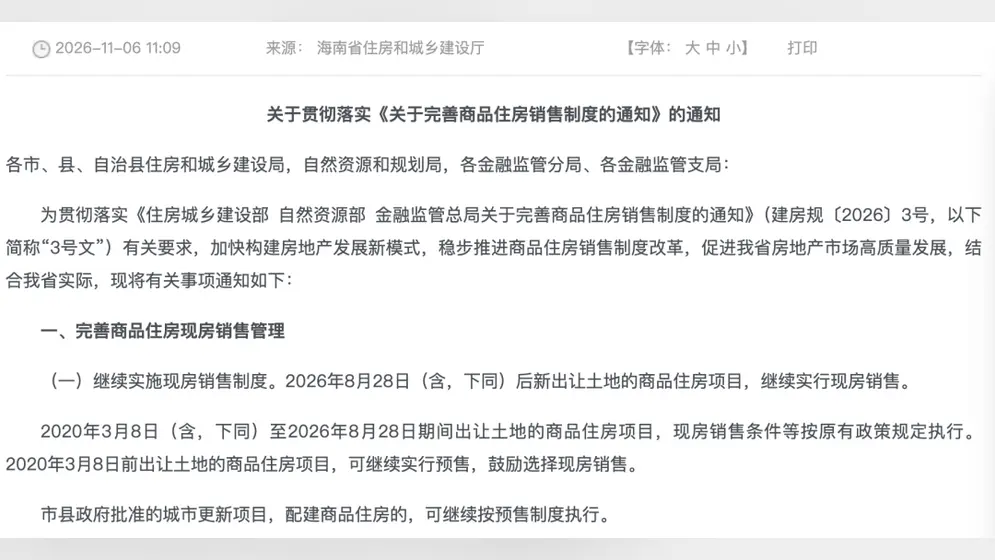
Hainan, the tropical island province at China’s southern tip, has told developers that homes must be sold after they are built rather than before. On November 6, several provincial departments jointly issued a notice to carry forward the on-completion sales model for commercial housing, framing it as part of building a new development model for real estate and promoting high-quality growth in the market.
The notice follows a national push to reform how commodity homes are sold. Hainan is not new to the idea: the province is probably the least unfamiliar place in China with the detailed rules for selling finished homes, having tested the approach in earlier stages. The document calls for steadily advancing the reform of the commercial housing sales system.
What has changed is the industry’s attention. According to a report on the policy, some top-tier developers have already sent management teams to Sanya to study the on-completion sales process. The same report says some property companies have already run through the entire workflow, from construction financing to handover and title transfer, without relying on pre-sale proceeds.
Under the longstanding pre-sale model, buyers pay for apartments still under construction, and developers use that cash to fund the build. That model helped fuel China’s property boom, but it also left homebuyers exposed when projects stalled. Selling only completed homes flips the financing burden onto developers, who must carry construction costs until the building is finished and inspected.
That is why the Hainan notice matters beyond the island. If developers can make on-completion sales work at scale, it offers a template for a national shift that many in the industry regard as inevitable but expensive. The visiting executives are there to learn how the numbers work: how much capital is tied up, how banks price construction loans, and how quickly completed units can be sold and handed over.
For buyers, the appeal is straightforward. A finished home can be inspected before money changes hands, reducing the risk of paying for an apartment that arrives late or never. For developers, the model rewards companies with stronger balance sheets and cheaper funding, and pressures those that depended on buyer deposits as working capital.
The notice does not set out every operational detail, and the province says it will proceed steadily. But the direction is clear: Hainan is positioning itself as the testing ground for selling homes the way most mature markets do, with the finished product on show before the contract is signed. Whether other provinces follow, and how quickly developers adapt their cash flow, will determine how far the model travels.
For global readers, the story is a window into how China’s property sector is trying to rebuild trust after years of delivery problems. The shift from pre-sales to completed sales is one of the most consequential changes in how Chinese homes are bought and financed, and Hainan’s experiment is being watched by builders far beyond the island’s beaches.