A Snack Giant With 30,000 Stores Draws a Regulatory Probe
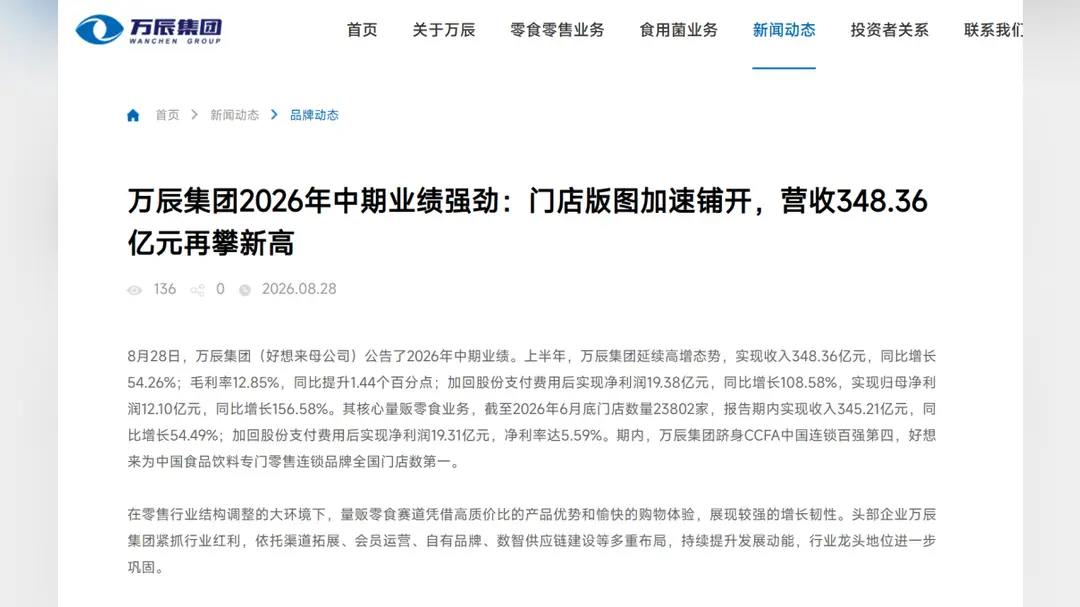
On the evening of November 2, Wanchen Group received a formal case-filing notice from China’s securities regulator. The listed company behind the snack chains Haoxianglai and Laoporenliang is being investigated for suspected disclosure violations, specifically an alleged failure to promptly disclose a related-party transaction. News of the probe landed barely a week after the company published one of the brightest quarterly reports in Chinese retail.
The numbers explain why the notice drew attention. In the first three quarters of 2026, Wanchen booked revenue of 55.628 billion yuan, up 52.15% year on year. That is the profile of a discount-snack operator expanding at speed, and the company has not been shy about the ambition behind it: a retail network that its backers have described in terms of tens of thousands of stores. For a business built on thin margins and rapid store rollout, scale is everything, and the market has treated Wanchen as one of the clearest winners of China’s value-retail boom.
Discount snack shops have spread across Chinese cities over the past few years. They sell branded packaged snacks, bottled drinks and confectionery at prices below convenience stores and supermarkets, relying on volume, cheap suburban locations and a supply chain of factory-direct sourcing. Haoxianglai grew into one of the largest such networks in the country, and the format has become a familiar sight on Chinese high streets — brightly lit, densely stocked, and priced to pull in students and young families.
That model has a well-known weak point. Franchised and affiliated stores mean a web of related parties: suppliers, logistics arms, franchisees and investment vehicles tied to founders or executives. When those relationships produce transactions, disclosure rules require the listed company to tell the market promptly. The regulator’s notice suggests it believes that did not happen in at least one case, without specifying which transaction or how large.
The timing is awkward in the way such timing usually is. A company that has just reported strong growth is precisely when investors are most willing to pay up for the story, and precisely when disclosure discipline matters most. A case-filing notice does not establish wrongdoing; investigations in China can take months and often end with a fine and a demand for corrective disclosure. But it does freeze the narrative, and it puts a question mark over how much of the growth came from transactions the market could not see.
For global readers, the episode is a compact lesson in how China’s consumer finance and retail story is regulated. The country’s discount retail sector has been one of the few bright spots in an economy where shoppers have become relentlessly price-sensitive. Companies that expanded fastest are now the ones whose governance is being tested. Wanchen’s franchise-heavy structure makes it a natural candidate for that scrutiny, and the outcome will shape how investors value the whole category.
What happens next will be watched closely. The company has not yet issued a detailed response to the notice. Investors will look for disclosure of the specific transaction at issue, any trading suspension, and whether the investigation widens beyond the original allegation. The store count will keep growing either way; the question is whether the paperwork grows with it.