China's Cities Have Empty Buildings and Waiting Demand. The Fix Is Rewiring Them
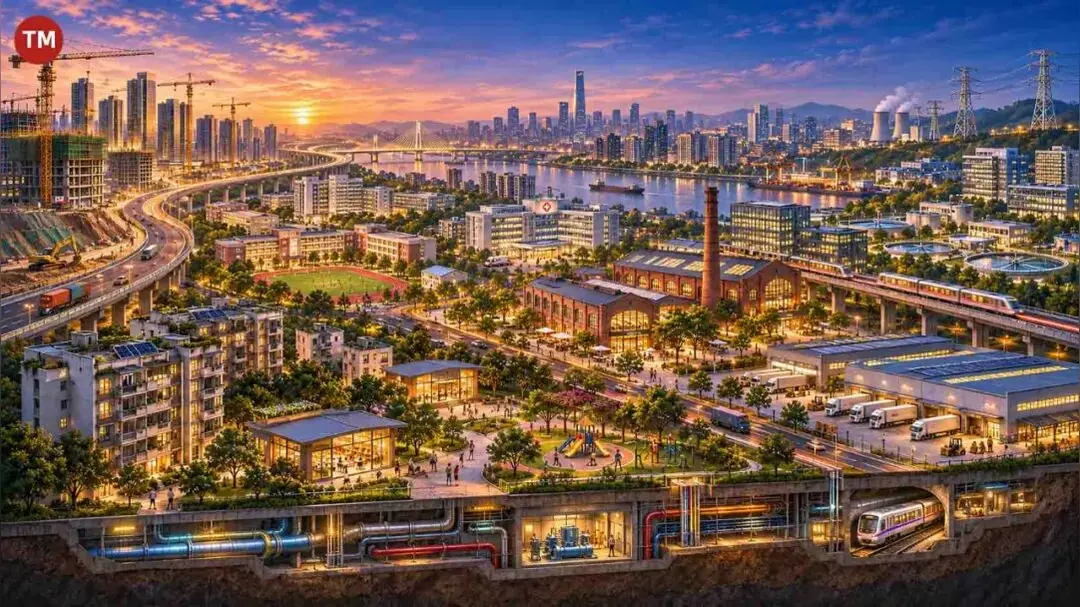
China spent decades pouring concrete, and the skyline shows it. The harder problem now, as a widely circulated financial commentary puts it, is that a great deal of demand is stuck inside space that already exists but no longer fits. Factories are still standing, yet companies that want to upgrade equipment run into limits on power supply, logistics and floor layout. Residential communities built years ago still lack suitable rooms for elder care, childcare and everyday services. Some office buildings sit empty for long stretches while other businesses cannot find premises that meet their needs.
The framing is deliberate. The assets have not vanished, and the demand has not disappeared either. What has failed to connect is existing capital with new kinds of use — a plumbing problem rather than a shortage problem. That distinction matters because it changes where the money goes. Building more is expensive and slow; adapting what is already there can be cheaper, faster and closer to where people actually live and work.
The author calls this city renewal, a phrase that in China covers far more than repainting facades. In practice it means re-engineering buildings for heavier electrical loads, adding loading bays and freight access to old industrial sites, converting underused floors into service space, and matching vacant premises with tenants whose requirements are specific. Each of those tasks is unglamorous, and each runs into the same obstacle: the incentives of the parties who own, occupy and regulate the space rarely line up.
That is why the piece treats urban renewal as a big strategic move rather than a construction programme. Retrofitting touches power grids, planning approvals, property rights and financing at once. A factory that needs a bigger substation is not simply a tenant with a request; it is a customer whose upgrade depends on a utility, a landlord and a local planning process all moving together. The same is true of a community centre that needs a licensed operator before it can offer elder care.
The economic logic is straightforward even without precise figures. China’s property construction engine has slowed sharply, and the country is looking for sources of investment that do not depend on selling new apartments. Upgrading existing buildings and industrial parks absorbs capital, employs construction and engineering workers, and produces something usable at the end — a different profile from a tower that stands empty.
The demand side is equally real. China’s population is ageing quickly, and families increasingly need childcare and services near home rather than across town. Small and mid-sized firms that want to automate need premises with the electrical capacity to run new machines. Neither group is served well by a market that has plenty of space and little of it suitable.
The commentary’s implicit critique is of a habit: treating construction as the measure of progress. Under that habit, the answer to almost any need is to build. Under the renewal lens, the first question becomes what is already there, who controls it, and what would have to change for it to be used differently. That is slower, more political in the small-p politics sense, and harder to photograph.
For international readers, the takeaway is that China’s next phase of investment may look less like new cities and more like rewiring old ones. The test will be whether financing and approval rules can be made flexible enough to let individual retrofits happen at scale, rather than staying as showcase projects in a handful of districts.