CATL's Stock Slide Tests the Battery Giant's Next Act
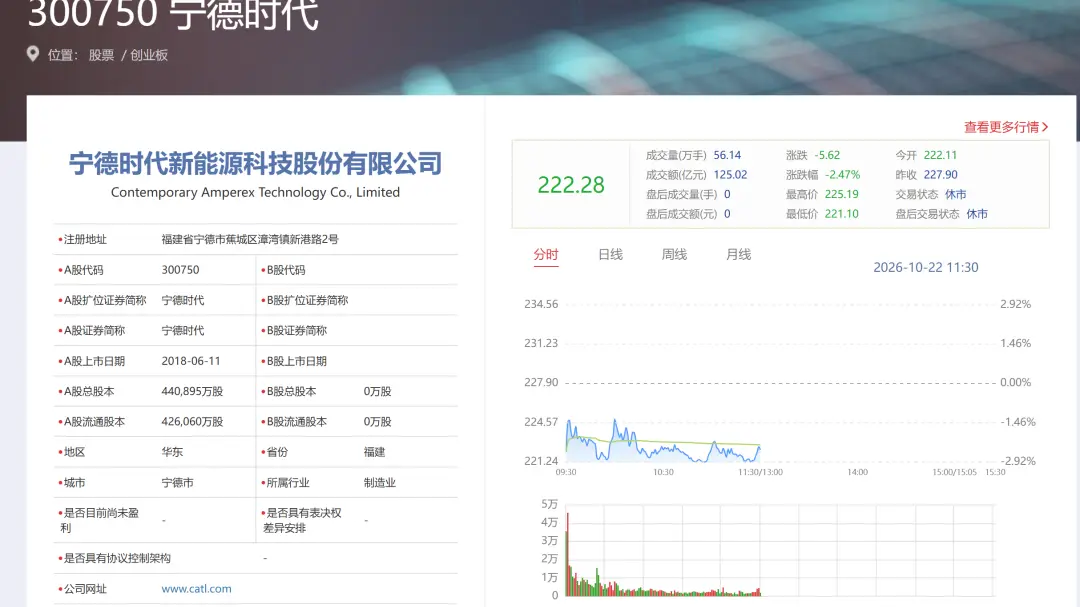
For years, CATL was the undisputed king of the electric-vehicle supply chain. Carmakers queued at its headquarters in Ningde, Fujian province, hoping to secure enough battery cells for their next models. That era of easy expansion is fading. On October 22, CATL’s Shenzhen-listed shares fell again, marking an eighth consecutive trading day of declines and dragging its market value back to roughly 1.03 trillion yuan. For a company that once seemed untouchable, the slide is a sobering signal.
The immediate trigger is a familiar one for investors: slowing profit growth. CATL still dominates the global battery market, but the pace of its earnings has cooled as competition intensifies and electric-vehicle demand in key markets matures. Rivals at home and abroad are catching up, and carmakers are deliberately cultivating second and third suppliers to reduce their dependence on any single battery maker. The result is a more crowded field and thinner margins than CATL enjoyed during its rapid rise.
The broader market backdrop has not helped. Hong Kong’s Hang Seng Index fell 2.87 percent in the morning session on October 22, with the tech-heavy Hang Seng Tech Index down 4.64 percent. Semiconductor and hardware names led the decline, and CATL itself dropped more than 5 percent at one point. Southbound funds recorded a net outflow of about HK$3.1 billion. When sentiment turns cautious, even the strongest industrial champions get repriced.
Yet the picture is not uniformly bleak. CATL remains central to China’s electric-vehicle ambitions and to global efforts to cut transport emissions. Its scale, research spending and manufacturing know-how give it advantages that newer entrants cannot easily replicate. The company has been expanding into energy storage systems, battery recycling and overseas production, bets that could eventually diversify its revenue beyond passenger cars. Those businesses, however, are still small relative to the core battery unit.
What investors want now is a clearer narrative about where future growth will come from. Building more capacity is no longer enough; the market is rewarding efficiency, technology and pricing power. CATL has signaled interest in next-generation chemistries, including sodium-ion batteries and faster-charging systems, but commercial scale remains a work in progress. Meanwhile, European and North American expansion carries its own costs and risks, from construction delays to shifting local-content rules.
The company’s rivals are not standing still. BYD, which builds both cars and batteries, has been expanding aggressively in Europe, where its new-car registrations nearly doubled in September, according to industry data. That kind of momentum in the world’s most competitive vehicle market puts pressure on CATL to prove that its technology advantage translates into durable profits, not just volume.
For global readers, CATL’s fortunes matter beyond one stock ticker. The company supplies a large share of the batteries inside electric cars sold worldwide, and its health is a proxy for the entire industry’s transition from rapid growth to mature competition. A cheaper, more efficient battery supply chain benefits automakers and consumers alike. But a slowdown at the sector’s biggest player also signals that the easy money in electric vehicles has already been made.
CATL’s next move will be watched closely. Whether it doubles down on energy storage, pushes deeper into overseas plants or unveils a breakthrough product, the company needs a story that convinces investors its best days are still ahead. For now, the market is waiting, and the eight-day slide is a reminder that even kings must keep proving themselves.