Ant's Ling 3.2 Flash Tries a Big Skeleton With a Small Switch
Ant Group’s BaiLing research team has released a new multimodal model called Ling-3.2-flash, and the headline number is a split personality: 560 billion total parameters, but only 25 billion switched on for any single step. The design follows the mixture-of-experts playbook — a large pool of learned knowledge, a small slice of it fired per token — which keeps the knowledge capacity of a giant model while holding down the cost of each forward pass.
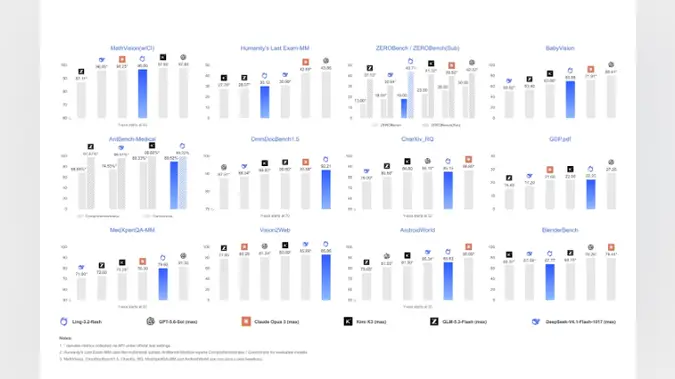
The team frames this as a balancing act rather than a raw size race. A dense model of comparable total size would be far more expensive to serve; a small dense model would be cheaper but thinner on knowledge. Ling-3.2-flash sits in between, and Ant positions it against Claude Opus 5, the frontier assistant from Anthropic, as a cheaper alternative for multimodal work.
Four capabilities were emphasized at launch. The architecture is natively multimodal, handling images, text and video rather than bolting a vision adapter onto a language model. It is tuned for complex visual understanding, meaning deep reasoning over images and video. It is built for long multi-step agent tasks, where the model must hold a goal across many turns and act on what it sees as well as what it reads. And it handles 3D content, a nod to Ant’s interest in spatial and design workflows.
The most practical addition is a feedback loop. Ling-3.2-flash can take the result of its own actions — a rendered image, a user interface, an error message — as new input and correct itself. If a tool call fails, it can locate the failure and retry rather than stalling. Ant also describes an anomaly-recovery mechanism that lets the model adapt when steps go wrong mid-task, which matters for agents that run unattended.
A million-token context window underpins that. Long contexts are what allow an agent to keep a task history, a codebase or a stack of documents in view without constant summarization, and they are becoming a standard claim among Chinese model releases this season.
The architecture pairs seven layers of one attention variant with a single layer of another, a hybrid pattern meant to cut the cost of processing long sequences. Ant has not published independent benchmark results, so the comparisons to Claude Opus 5 remain the company’s own framing for now.
The release lands in a crowded stretch for Chinese AI. Moonshot AI’s Kimi Hosted Agents, Google’s Omni 1.2 Flash and an open-source small model from Taobao’s MNN team all arrived in the same news cycle, and Alibaba’s Qwen family is already embedded in Siri for Chinese users. For developers, the practical question is less which model tops a leaderboard than which one is cheap enough to leave running on long tasks.
Ant’s pitch is squarely on that axis: frontier-adjacent multimodal reasoning at activation costs closer to a mid-size model. Whether enterprises buy it will depend on whether the self-correction actually holds up outside demos — and on pricing Ant has not yet disclosed.