Ant Group's OceanBase Wins Wuzhen Award for AI Data Platform
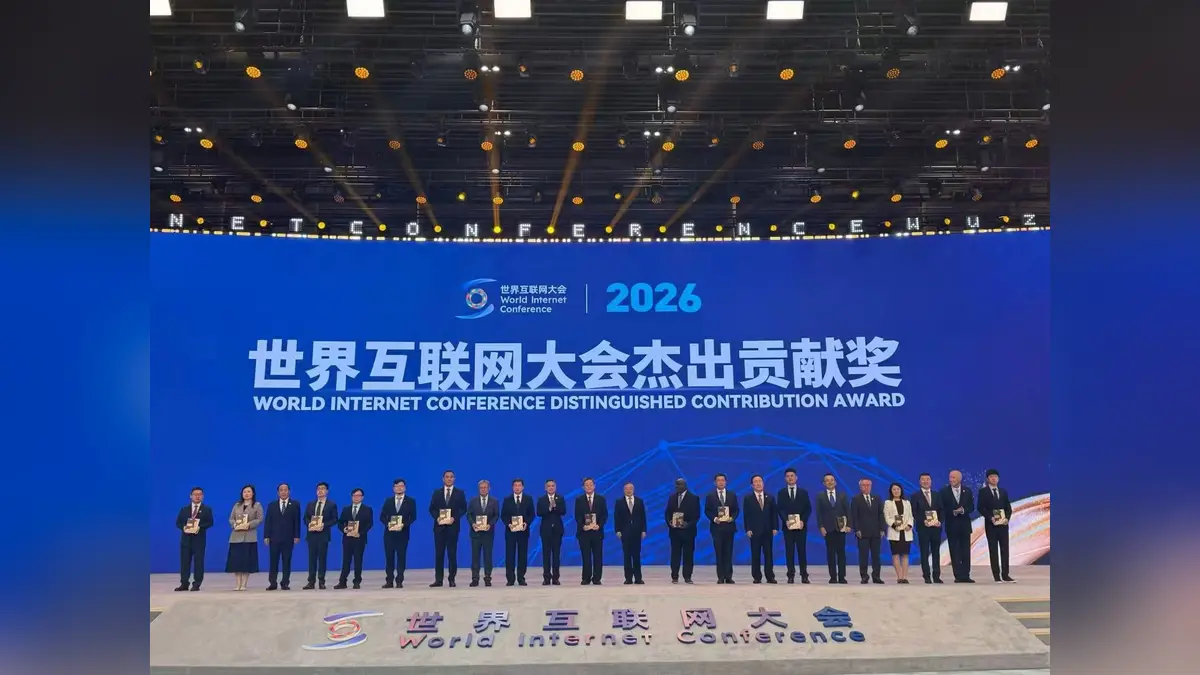
The 2026 World Internet Conference opened on November 3 in Wuzhen, a canal town in Zhejiang province, and the awards stage offered a clear snapshot of where China’s AI money and engineering effort are heading. OceanBase, the database company spun out of Ant Group, took the Outstanding Contribution Award for what organizers described as AI data infrastructure serving a broad set of users. The recognition matters because OceanBase began life as an internal system for Alipay’s payment traffic and has spent the past few years repositioning itself as a platform for training and serving large models, where data pipelines and storage bottlenecks often decide how fast a model can ship.
Xiaomi had a busy morning at the same event, collecting two separate honors. The Xiaomi Group received the Outstanding Contribution Award in the innovation-breakthrough category, while its robotics arm won a Leading Technology Award for a general-purpose robot manipulation foundation model aimed at scaled deployment. The pairing is telling: Xiaomi is best known for phones and cars, but the company has been steadily building an embodied AI stack that it hopes will sit inside factories and homes rather than only on a screen.
AgiBot, a Shanghai-based embodied AI startup, also received the Outstanding Contribution Award. A senior partner at the company used the podium to argue that the endpoint of artificial intelligence is not a screen but physical machines that act in the world. That line has become a common refrain among Chinese robotics founders, who are competing to turn humanoid prototypes into products with real customer orders.
The conference is not only a ceremony. Siemens, the German industrial giant, marked its ninth consecutive year at the China International Import Expo nearby, with a booth focused on industrial AI. The company said it would show applications in high-growth sectors such as data centers and humanoid robots, alongside more than 40 customer cases where AI and low-carbon technology have been deployed on real production lines. For Siemens, the pitch is that global engineering experience can be multiplied by local Chinese speed.
On the Hong Kong side, Ant Group’s technology arm used Hong Kong FinTech Week, which opened on November 2, to present what it calls an AI agent super factory — a stack for developing, deploying and coordinating multiple agents inside a company — and a new identity-governance scheme called KYA, designed to verify that an agent acting on a company’s behalf is who it claims to be. The security question is becoming urgent as more firms let software agents touch payments, contracts and customer records.
Away from the stages, the harder economics of AI were on display in industry discussion. Inference — running trained models to answer real queries — is shifting the cost structure of computing, and analysts argue that chip vendors and cloud providers need a new accounting framework for a world where most spending goes to serving rather than training. Transsion, the Shenzhen handset maker that built its business on low-cost phones in Africa, is meanwhile juggling memory-price inflation, inventory and a cautious Hong Kong listing while placing its own AI bet.
The through-line across Wuzhen, Hong Kong and Shanghai is that Chinese AI firms are moving from model demos to infrastructure, agents and robots. Awards are a lagging indicator, but the categories chosen this year suggest where the next round of competition will be fought.