Kimi K3.1 Pro Leaks Ahead of Launch as Moonshot Teases a 3-Trillion-Parameter Model
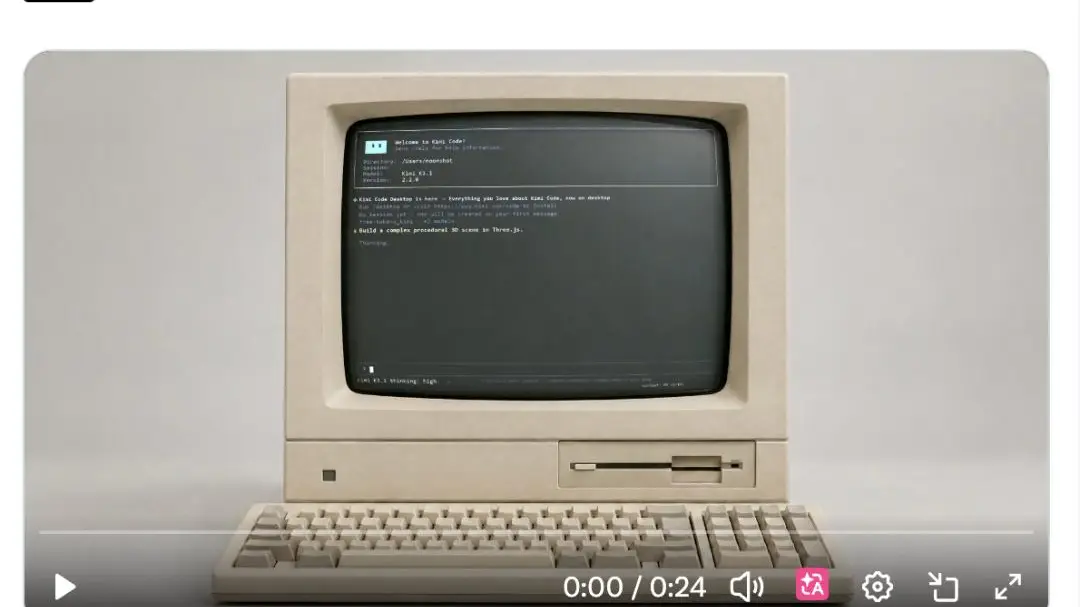
Chinese AI developer Moonshot AI has officially released Kimi K3.1 Pro, the first model in its K3.1 family and, by the company’s own account, the most capable system it has built. The model sits on a 3-trillion-parameter architecture, a scale that places it among the largest flagship large language models produced in China. The rollout was not a complete surprise. A 24-second teaser video, posted without warning, showed an old desktop monitor running Kimi Code, a coding tool, while a terminal wrote a script that used Three.js to generate a complex 3D scene. Observers quickly noticed the model selector in the top-left corner of the screen read Kimi K3.1.
Days earlier, on 22 October, a mystery model appeared on Arena, the public model-comparison leaderboard where anonymous systems are tested against rivals. Users spotted the codename Kibitz and began comparing it with GPT-6 Astra Max and Claude. Several claimed to have traced tokenizer fingerprints and other small clues back to Moonshot, concluding that Kibitz was Kimi K3.1 in disguise. The official launch confirmed the speculation, and a faster variant, K3.1 Pro Highspeed, is being released alongside the standard model.
The timing is pointed. Kimi K3.1 and Zhipu’s GLM-5.5, two of the most anticipated flagships in China’s model lineup, are both surfacing before the end of the month. Chinese developers have grown used to this pattern: a frontier lab quietly seeds a model onto a public leaderboard, watches how it performs against foreign rivals, then launches with a marketing push built on the results. For Moonshot, the leaderboard run doubles as a stress test and a preview.
The release also lands in a crowded moment for personal AI. Over the past month, Alibaba has pushed its Qwen Go assistant, Tencent has explored a standalone personal agent, ByteDance has extended agents into phone-level software, StepFun has shown an agent-centric handset, Ant Group has upgraded its Lingguang product, and startup Today AI has raised more than 200 million dollars. Most of those products ultimately depend on a capable base model underneath, which is the market Moonshot is selling into.
Parameter count alone no longer decides a model’s value. Chinese labs have spent the past year shifting emphasis from raw size toward tool use, long-context reasoning and the ability to operate software without supervision. Kimi’s pitch has leaned on coding and agentic tasks, and the teaser video was chosen to show exactly that: a model writing working 3D code in a terminal rather than answering trivia. Whether the 3-trillion-parameter figure translates into better real-world output, or mainly into higher serving costs, is the question buyers will ask.
One clue to how seriously the market takes the launch is that Moonshot skipped the usual build-up. There was no countdown, no launch event, no founder interview. A short clip and a quiet Arena listing did the work. That confidence suggests the company believes benchmark results will speak for themselves once independent testers get access.
For global observers, Kimi K3.1 Pro is a useful marker of how fast China’s frontier labs are shipping. The next signal will be the first independent Arena rankings and coding benchmarks for Kimi K3.1 Pro, plus early developer reports on whether the high-speed variant holds quality at lower latency. Those numbers, not the parameter count, will decide whether Moonshot’s flagship earns a place in products built outside China.