A 0.016% Weight Tweak Cured Qwen's 30,000-Token Loop
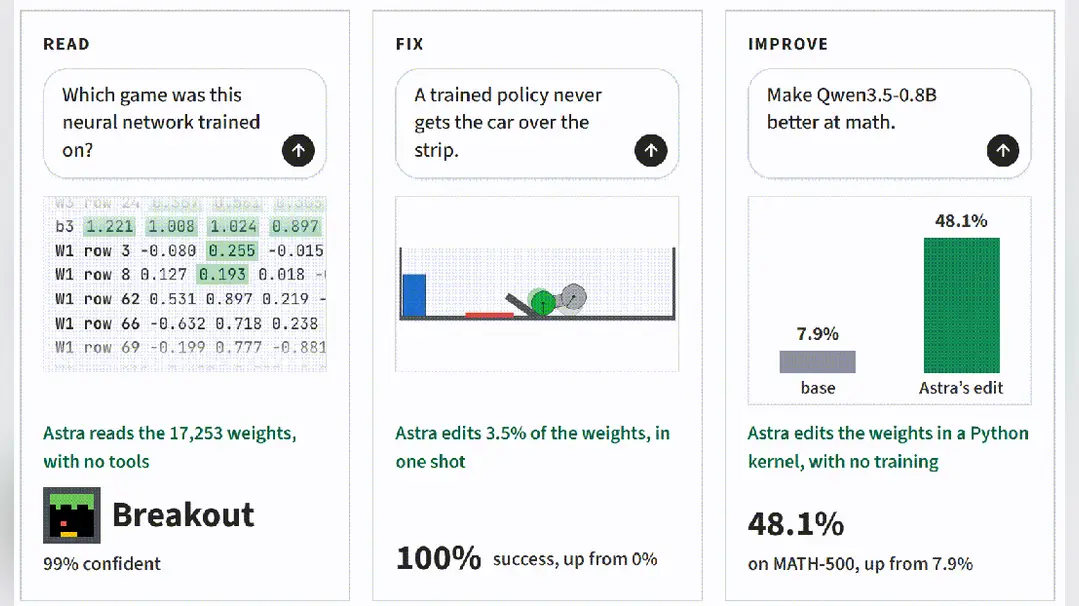
A reasoning model kept working a maths problem past 30,000 tokens, repeating the same steps and never delivering an answer. The failure mode is familiar to anyone who has watched a large language model spiral: more thinking, no progress. The fix described in a widely shared Chinese technical write-up was not a new training run but a surgical edit to a tiny fraction of the model’s parameters — about 0.016% of the weights, according to the account.
The mechanism is the interesting part. The same model was used both to read its own weights and to rewrite them. In conventional practice, improving a model means gradient descent: feeding it examples, computing loss and nudging millions or billions of parameters over many hours. Here, the model inspects its internal state, diagnoses what it calls a loop, and applies a targeted correction. The write-up frames this as a shortcut channel for AI improving AI that bypasses gradient descent entirely.
Qwen is the model family developed by Alibaba, one of China’s largest technology companies, and its open-weight releases have made it a common base for researchers and hobbyists worldwide. The loop problem is not unique to Qwen. Long chain-of-thought reasoning models from several labs have shown a tendency to overthink, burning tokens on redundant steps and sometimes failing to stop. Token consumption is also a cost: every extra thousand tokens is billed compute.
If the result holds up, the implications cut two ways. On one side, model maintenance becomes cheaper and more precise — a model could patch its own recurring failure modes without a full retraining cycle. On the other, the boundary between maintaining a model and amplifying its capabilities starts to blur. A system that can read and rewrite its own weights is a system that can, in principle, change what it is. The write-up says as much: the line between model maintenance and capability scaling becomes fuzzy.
The claim arrives with caveats. A single reported case of breaking one loop is not evidence of a general method. Whether the edit generalises — whether the model still reasons correctly on other problems after the weight change — is the question any such result must answer. The 0.016% figure is striking precisely because it is small, but small edits can have large, unpredictable effects elsewhere in a network.
The broader context is a busy stretch for Chinese AI research. In recent weeks, teams have published work on agents that teach themselves in loops, on open-sourced inference engines and on models trained entirely on domestic chips. Self-modification sits at the more speculative end of that spectrum, but it is attracting attention because it targets a real operational headache: models that waste tokens going nowhere.
For global readers, the practical takeaway is that the frontier of model improvement is widening beyond bigger training runs. Weight-level editing, self-diagnosis and loop-breaking are becoming research topics in their own right. The next signal to watch is replication: whether independent groups can reproduce the fix on other models and show that the edited network remains stable across tasks, not just on the problem that prompted the edit.