Five AI Lab Projects Step Into the Light at Beijing Roadshow
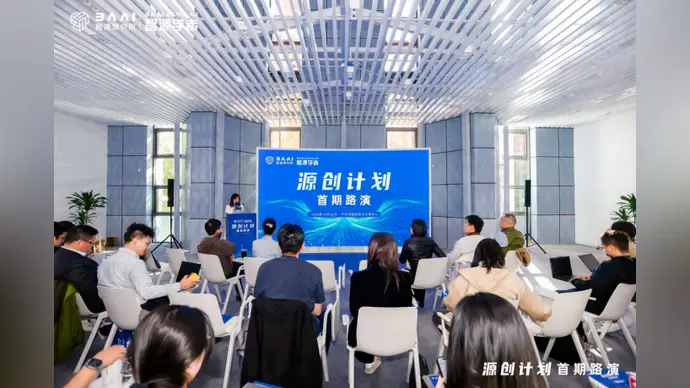
Five AI hardware projects pitched investors in Beijing on October 26 at the first public roadshow of the Yuanchuang programme, an initiative run by the Beijing Academy of Artificial Intelligence, a state-backed research institute known as Zhiyuan. The ventures — Linjiekai Technology, Lingshu Qizhi, Zhangliangchang Technology, Cangqiong Jizhi and Qianxiangliang Technology — work on foundational chips, neuromorphic computing, autonomous robot deployment, physical intelligence for extreme environments and modelling of surface terrain.
The pitch was less about breakthroughs than about the awkward middle: the stretch between a working prototype and a product someone pays for. Engineering validation, supply chains and first customers are where lab-born ideas usually stall, and the roadshow was designed to put founders in the same room as industrial partners and early capital.
Zhiyuan has spent recent years building a cohort of affiliated researchers and spinning out work through programmes that pair academic teams with commercial mentors. Neuromorphic chips, which mimic the brain’s signalling to cut power use, and physical-world modelling, which gives robots a usable picture of their surroundings, are both fields where Chinese labs have published heavily but shipped little.
Whether these five become companies or cautionary tales will depend on orders rather than papers. The measure to watch is how many announce a first paying customer, and in which industry, over the next year.