Baidu's New OCR Model Reads All Seven Harry Potter Books at Once
Optical character recognition, the technology that turns pictures of text into editable words, has long come with a ceiling. Most systems handle a few dozen pages before accuracy slips or memory use balloons. On October 27, Baidu released and open-sourced a model it calls Wenxin Unlimited OCR 2, which it says removes that limit entirely.
The company describes the release as the first time any model has achieved arbitrary-page document parsing, pushing the processing ceiling from dozens of pages toward what it calls unlimited. In a demonstration, the model read all seven Harry Potter novels in a single run, a total of more than 3,600 pages, while maintaining high accuracy and processing speed as the document length grew.
The technical trick is an attention mechanism the team calls SR-SWA. Instead of holding every page in memory at once, the model works the way a person copying a long book might: it scans ahead, selects the pages and information blocks that matter for the current passage, and sets the rest aside. A chunked decoding mechanism then assembles the output. Baidu says this approach cut peak KV cache use in a hundred-page test from 47 gigabytes to a small fraction of that, making long documents practical on ordinary hardware.
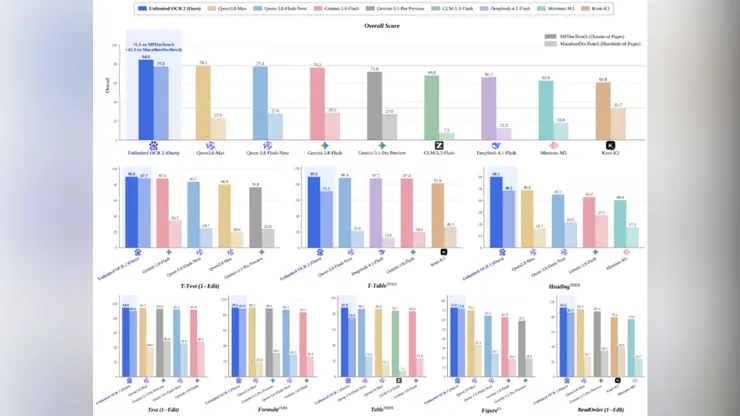
Public benchmarks for multi-page document parsing, including the widely watched M-prefixed tests, show the model reaching state-of-the-art results, according to the company. Baidu is framing the release as the arrival of an OCR 3.0 era, in which document parsing is judged not by how well a model reads one page but by how reliably it handles an entire archive.
The practical stakes are large. Contracts, court files, medical records, historical archives and academic libraries all arrive as stacks of scanned pages. A model that can ingest them in one pass could change how law firms, hospitals and publishers digitize their backlogs. It could also feed long documents directly into AI assistants, which have struggled with context windows and retrieval when asked to reason across hundreds of pages.
Open-sourcing the model lowers the barrier for developers who want to build document tools without paying per-page fees to a cloud provider. Baidu has been positioning its Wenxin family as a foundation for both its own products and outside developers, and releasing the OCR model for free fits that strategy.
The claim of unlimited pages will invite scrutiny. Independent tests will need to confirm that accuracy holds on messy real-world scans, handwriting and tables, not just clean book pages. Still, the demo is a striking one: a single model reading an entire seven-book series in one go is the kind of concrete benchmark that tends to stick.
For global readers, the release is a reminder that China’s AI labs are competing hard on practical engineering as well as headline model sizes. Document parsing is unglamorous work, but it sits underneath a huge share of enterprise AI adoption. If the model performs as advertised, the next battleground will be who can turn long-document understanding into everyday office tools first.