China's Century-Old Canal Is Ready, and It Comes With an Animal Bridge
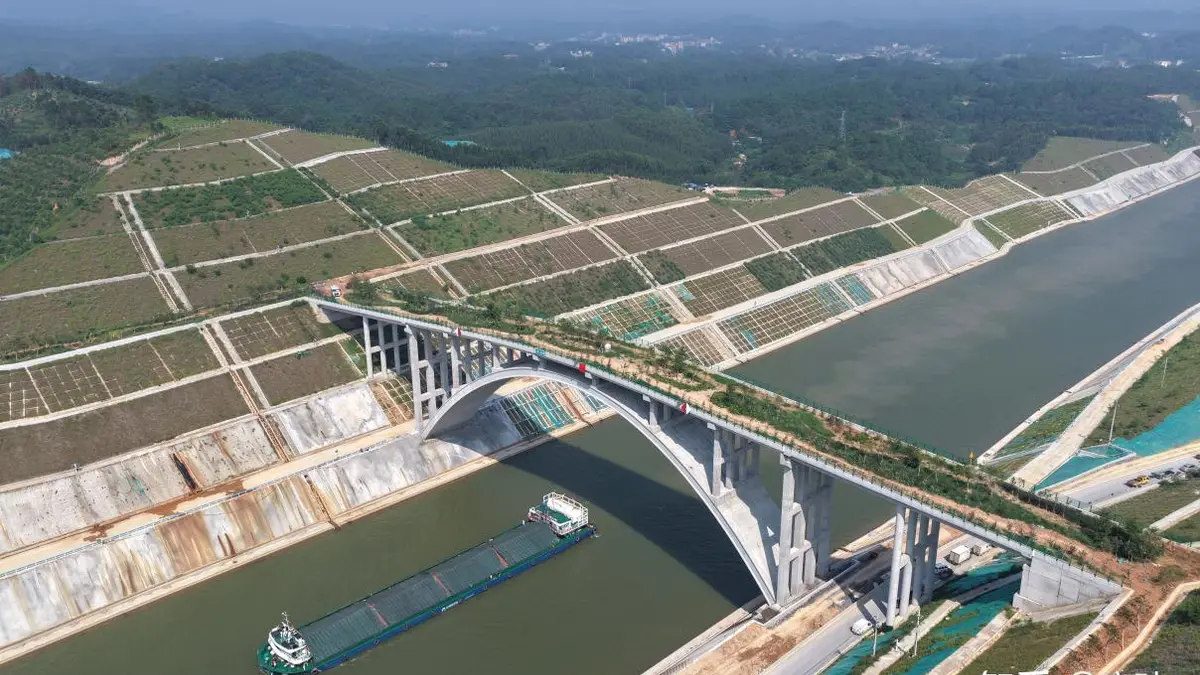
A canal that engineers first imagined nearly a hundred years ago is finally becoming a reality in southern China. The Pinglu Canal cuts across the Guangxi region, connecting the Yu River to the Qin River and, through it, to the sea. For a landlocked stretch of southwest China, the project promises something it has never had: a direct water route to the coast.
The idea is not new. Planners sketched versions of this link as far back as the 1920s, but the terrain made it daunting. The canal must cross a mountain ridge, meaning engineers had to carve a channel straight through a range that had long separated two river systems. When the digging is done, the Yu and Qin rivers will meet for the first time in their natural histories, and the canal will thread through the gap.
That engineering feat comes with an ecological puzzle. Cutting a channel through a mountain also cuts a continuous stretch of forest in two. Animals on one side lose access to the other. Habitats that were once connected become isolated islands, and over time, isolated populations can weaken.
Tang Wei, an environmental design lead on the project, described the team’s approach in a post shared on the Chinese Q&A platform Zhihu. Rather than treating wildlife as an afterthought, the designers built movement back into the landscape. The most visible example is a bridge meant specifically for small animals — a crossing that lets them move between the two sides of the new channel without braving the water.
Such structures are not unique to China. Wildlife overpasses and underpasses have become common in parts of Europe, North America and Australia, where highways slice through animal territory. What makes the Pinglu case notable is the scale and the setting: a major shipping canal, carved through a mountain, in one of China’s most biodiverse regions.
The canal’s economic ambitions are just as large. Guangxi sits on the coast but has long lacked a fully efficient inland waterway link to its own ports. Goods from the southwest often travel long distances overland or take a roundabout river route. A direct channel could shorten journeys, lower shipping costs and pull more trade toward the Beibu Gulf ports.
Whether that translates into a boom for the region is an open question. Canals have reshaped economies before, but they also require maintenance, water management and careful planning to avoid bottlenecks. Supporters argue the link will strengthen Guangxi’s role as a gateway between China and Southeast Asia. Skeptics note that infrastructure alone rarely transforms a region without supporting industry and logistics.
For now, the canal’s most memorable feature may be the smallest one. A bridge built for animals is easy to overlook next to a mountain cut in half. But it reflects a shift in how large projects are discussed in China — not only as feats of engineering, but as interventions in landscapes that other species also call home.