Minecraft Becomes AI's Toughest Test as Labs Race to Beat the Game
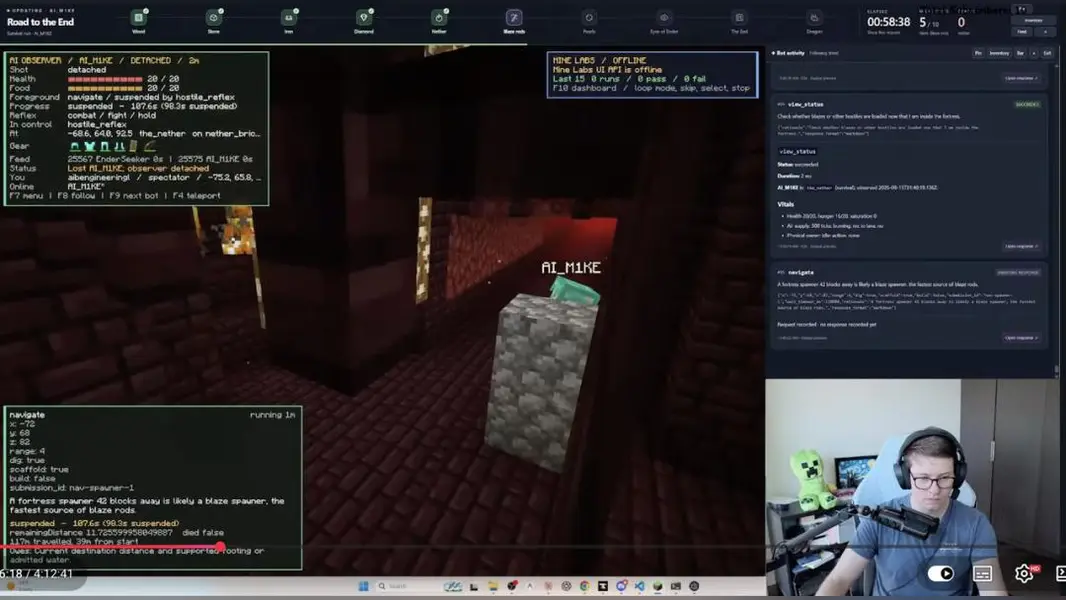
Silicon Valley’s most sought-after AI researchers have a new obsession, and it is not a chatbot or a coding assistant. It is Minecraft. The blocky survival game, where players punch trees for wood, dig for ore, craft tools and eventually hunt a dragon, has become the latest proving ground for autonomous AI agents. The question is simple to state and hard to answer: can a machine learn to play a long, open-ended game from zero, the way a human child might?
Getting good at Minecraft requires more than reflexes. An agent must set its own goals, remember what it has seen, plan across thousands of steps and recover from mistakes. A wrong turn in a cave can mean losing everything. That combination of exploration, memory and long-horizon planning is exactly what today’s large language models still struggle with, which is why labs have turned the game into a benchmark.
The approaches vary. Some researchers let a single model, such as Claude, attempt the game alone, learning by trial and error. Others experiment with faster, more specialised agents. Google recently took a different route, putting four Gemini models on a team and letting them cooperate from a standing start, dividing chores and sharing information as they work toward the same goal. Each method reveals something different about how AI systems fail and recover.
The results are published as papers and compared on leaderboards, turning a hobbyist’s sandbox into a competitive arena. That competition matters because the skills being tested are not confined to games. An agent that can survive a night in Minecraft, build a shelter and plan a route to a distant objective is demonstrating the same abilities needed for real-world tasks, from warehouse robots to software that books travel and manages schedules.
Minecraft is not the first game to serve this purpose. Board games such as chess and Go were conquered years ago, and video games have long been used to test AI. But most of those games have fixed rules and clear winners. Minecraft is open-ended, with no single correct path, which makes it a closer stand-in for the messy, ambiguous problems that agents will face outside a laboratory.
The interest also reflects a shift in how the AI industry measures progress. Benchmark scores on static tests are increasingly seen as easy to game or overfit. A game that takes hours to finish, and where every decision compounds, is harder to fake. That has made Minecraft a popular way for labs to show off, and a useful way for outsiders to judge whether an agent is genuinely capable or merely good at short bursts.
For now, no model has convincingly beaten the game without help. But the race itself is revealing. Each new attempt produces lessons about memory, planning and teamwork that feed back into the next generation of models. For a global audience, the takeaway is that the next leap in AI may not come from a bigger chatbot, but from a machine that can learn to survive a world it has never seen.