Tencent Open-Sources a Simultaneous Interpreter That Beats Human Latency
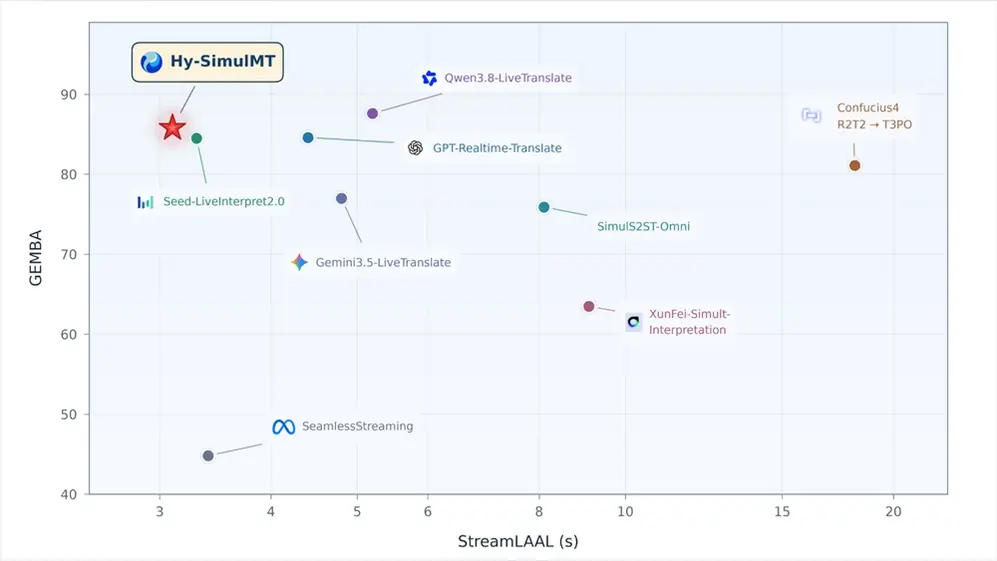
Tencent’s Hunyuan research team released and open-sourced a simultaneous translation model called Hy-SimulMT on October 26, built for the kind of live interpretation that normally requires a trained human in a soundproof booth. The model takes audio from a speaker and outputs translated speech while the speaker is still talking, moving between Chinese and English in both directions without waiting for a full sentence to finish.
The headline number is latency. Tencent says the system responds in about three seconds, against an average of four to five seconds for professional human simultaneous interpreters. In simultaneous work, those seconds are the whole game: the longer the lag, the more the audience loses the thread, and the harder it becomes for a speaker and interpreter to stay in sync. The company also claims its translation quality reaches the level of human conference interpreters on several evaluations, ahead of mainstream open-source models and most commercial APIs.
The feature likely to draw the most attention outside translation circles is real-time timbre cloning. Hy-SimulMT reproduces the speaker’s voice and tone in the output audio, so a Chinese speaker’s English delivery sounds like that person rather than a generic synthetic voice. That is a meaningful step for meetings, livestreams and travel, but it also raises familiar questions about voice data and consent that any cloning-capable system invites.
Tencent has put the model into its Hy translation app as a free first-look experience, and the code and weights are available on HuggingFace, ModelScope and GitHub. Opening the model rather than keeping it behind an API follows a pattern now common among Chinese AI labs, which often use open releases to build developer ecosystems and credibility while commercial rivals keep their best systems closed.
Simultaneous interpretation has become a crowded frontier. The problem suits AI well because it rewards low latency, steady output and the ability to handle messy, overlapping speech, all areas where large speech models have improved sharply. It is also one of the few AI tasks with an obvious, measurable human benchmark: professional interpreters, whose speed and accuracy provide a yardstick anyone can understand.
For global audiences, the practical effect is less about replacing interpreters than about widening access. A three-second speech-to-speech pipeline that runs on a phone could make a business call, a factory walkthrough or a hospital conversation possible across a language barrier without booking a service. The voice-cloning layer makes the experience feel less mechanical, though it also means the technology can imitate a person’s speech in a language they do not speak.
The next test is real-world use. App reviews and developer projects built on the open weights will show whether the three-second response holds up on noisy audio, strong accents and technical vocabulary, where lab evaluations tend to flatter a model. Tencent’s move also puts pressure on rivals to publish comparable latency figures, which would give buyers a clearer way to judge a market that has so far run mostly on demo videos.