China's Snow Dragon Puts the Arctic Ocean Through a Health Check
Aboard the icebreaker Xue Long, a shout of “water’s coming up!” is enough to empty the corridors. Researchers drop what they are doing and hurry toward the CTD room, where a carousel of twenty-four bottles has just been hauled back from the deep. Each bottle holds ten litres of seawater, and every one of them matters.
CTD stands for conductivity, temperature and depth, the three things the instrument measures as it sinks. Oceanographers call the routine a health check for the ocean, and on China’s 16th Arctic expedition the metaphor is meant almost literally. The team lowers the package to chosen depths, closes bottles on command, and brings back water from layers that rarely, if ever, mix.
That is where Zheng Xinyu comes in. She describes herself as the middle variable in the operation, the person who decides which sample goes into which container. Water from different depths carries different chemistry, different traces of life, different stories about where it has been. Mix them up and months of work at sea become noise.
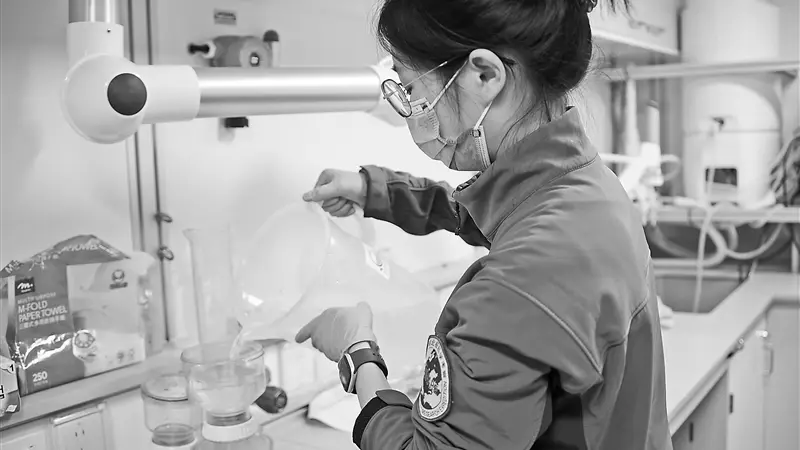
Once on deck, the water fans out across the ship’s laboratories. Some is filtered for chlorophyll and tiny drifting organisms, the base of the polar food web. Some is fixed for nutrients, gases or salts. Some is frozen and stored for analysis long after the ship returns home. Filtering is slow, repetitive work, and the photograph of researcher Ning Wenfeng bent over a filtration rig captures its rhythm better than any logbook.
The Arctic rewards this patience with urgency. The region is warming several times faster than the global average, and its sea ice has been shrinking and thinning for decades. The Bering, Chukchi and Beaufort seas that the expedition samples are the front line of that change, where warmer Atlantic and Pacific waters push north and reshape what can live there.
Measurements taken this year will be compared with earlier Chinese cruises and with data from international partners. No single bottle of water proves anything. But a long, consistent record of temperature, salinity, nutrients and biology is how scientists separate a strange season from a genuine trend, and how computer models of the global climate get corrected.
The work also has a human texture that rarely makes it into journals. Sample bottles are numbered, logged and carried through narrow corridors on a ship that is always moving. Watches run around the clock. The same hands that tighten a valve at 3 a.m. will be filtering water at noon, because the ocean does not pause for sleep.
For readers far from any ice, the payoff is less abstract than it sounds. What happens in the Arctic reshapes weather patterns that reach Europe, North America and East Asia, influencing where rain falls and how hard winter bites. A health check on the far north is, in a small way, a check on everyone else’s forecast. The bottles come up cold, but the numbers they carry travel a very long way.