Why a Sheet of Paper Breaks a Cat's Brain
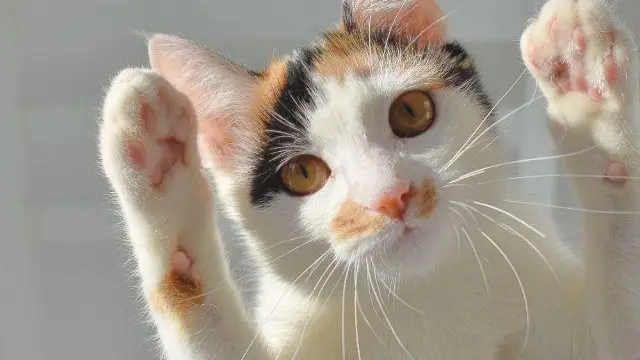
A small piece of paper taped to a cat’s forehead has become one of the internet’s favorite puzzles. The cat notices, lifts a paw to brush it off, then suddenly lowers its head and starts grooming its paw instead. It reaches up again, and again stops to lick. Chinese social media users call this a “bottom-layer code conflict” — as if the cat’s software is running two programs at once and crashing.
The joke is funny, but the behavior is real, and animal scientists have studied it for more than eighty years. The paper trick is a simplified version of classic experiments on what researchers call displacement behavior: when an animal faces two conflicting urges, it often performs an unrelated, everyday action instead. For a cat, that action is frequently grooming.
In the 1940s, Dutch biologist Nikolaas Tinbergen and his colleagues studied how animals respond to competing drives. Tinbergen later shared a Nobel Prize for work showing that behavior follows predictable, inherited patterns. A cat that wants to remove the paper but feels uneasy about the unfamiliar thing on its face finds itself caught between approach and avoidance. Grooming is a familiar, low-risk routine that seems to release the tension.
This is why the cat looks so “neural” — not broken, but overloaded. Its attention flips between the paper and its own paw, and each flip triggers a well-worn habit. The same pattern shows up in many species. Birds peck at the ground when they are torn between fighting and fleeing. Dogs scratch or yawn at moments of mild social stress. Humans bite their nails or check their phones.
Grooming also has practical value for cats. It keeps fur clean, regulates temperature, and spreads natural oils. Because it is so deeply wired, it becomes the default action whenever the animal is uncertain. In that sense, the paper is not confusing the cat. It is revealing a system that evolved to keep moving even when no clear choice exists.
None of this means the trick is harmless fun to repeat. Animal welfare experts generally advise against deliberately stressing pets for entertainment, even mildly. A quick, gentle test may be fine, but the cat should be able to walk away, and the paper should never cover the eyes, nose or mouth.
The larger lesson is about how we read animal minds. What looks like a glitch is often a sensible response to a messy situation. Cats live in a world of smells, textures and sudden movements, and their brains prioritize quick, practiced reactions over slow deliberation. When two reactions collide, the result can look absurd from the outside.
So the next time a cat freezes mid-reach and starts licking its paw, remember: it is not running bad code. It is running very old code, written long before anyone thought to film it for the internet. The paper is new. The cat’s answer to it is not.