Tesla's China Sales Fall Below 10,000 for the First Time in 51 Months
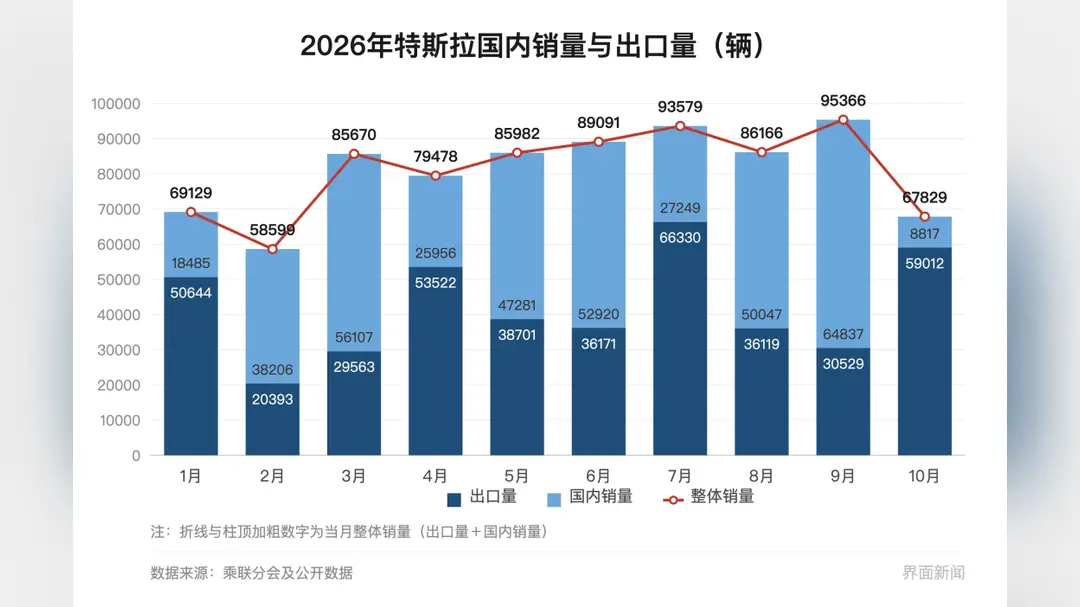
Tesla’s China business hit an uncomfortable milestone in October. The company sold 8,817 vehicles in the country last month, according to figures reported by Chinese media, the first time its monthly domestic sales have fallen below 10,000 since July 2022 — a gap of 51 months. Compared with the 26,000-odd cars it sold in October 2025, that is a drop of 66.1%. Even last October, already a seasonal low point for Tesla in China, was far stronger than this.
The most striking detail is the Model Y. The crossover has been Tesla’s volume workhorse in China and was the country’s best-selling passenger model as recently as September. In October it fell to 66th place on the monthly sales chart. That kind of swing — from first to 66th in a single month — is unusual even in China’s fast-moving car market, and it points to something more than a slow month.
One likely explanation is timing. Tesla ran a promotional campaign in September and appears to have concentrated deliveries into that month, pulling demand forward and leaving October thin. Automakers in China report wholesale and retail figures monthly, and a big push at the end of a quarter can distort the following month’s numbers. Tesla has used price cuts, insurance subsidies and limited-time financing offers repeatedly in China to keep volumes up, and each round tends to borrow sales from the near future.
But the broader picture is harder to dismiss. China’s electric vehicle market is the most competitive in the world, with BYD, Geely’s various brands, Xiaomi, Xpeng, Nio and a long list of state-backed and private rivals releasing new models at a pace that would be unrecognisable in Europe or North America. Tesla’s lineup in China still rests on the Model 3 and Model Y, both of which are now older designs facing fresher competition at every price point. Local brands have also become faster at adding features Chinese buyers expect, from larger screens to advanced driver-assistance systems tuned for domestic roads.
The October figure matters beyond Tesla. China is the world’s largest car market and the company’s biggest manufacturing base outside the United States, with its Shanghai plant supplying both domestic buyers and exports. A weak domestic month does not automatically mean weak production — cars can be shipped abroad instead — but it does suggest Tesla is losing pricing power in the market that once made its global numbers look easy.
For global readers, the lesson is about how quickly leadership changes in China’s EV sector. A model that tops the charts in September can be mid-table in October, and a brand that defined the category a few years ago now has to fight for every sale. Tesla’s response — whether another round of incentives, a refreshed model, or a shift toward exports from Shanghai — will be watched closely by rivals and suppliers alike.
The next monthly sales report will show whether October was a one-off caused by September’s delivery push or the start of a longer slide. Either way, the numbers from China are now the clearest early warning system for Tesla’s global momentum.