Dongfeng's M-Hero Bets on Family Comfort With New X700 SUV
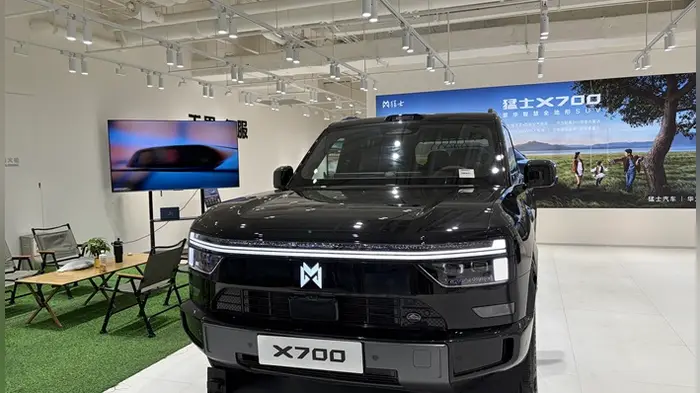
For four years, M-Hero has built its reputation on ladder-frame, body-on-frame off-roaders meant for rock crawling and desert runs. This week the Dongfeng Motor sub-brand did something it had long resisted: it compromised. The X700, now sitting in the center of a Beijing showroom, is M-Hero’s first model built on a unibody chassis, the same basic construction used by ordinary passenger cars. It is a deliberate pivot from hardcore capability toward the much larger family market.
The trade-off is visible in the specifications. M-Hero dialed back professional off-road hardware and pushed resources into cabin space, ride comfort and intelligent features. The pitch is simple: most buyers of boxy SUVs in China never leave the asphalt, and they care more about a quiet highway ride and a rear seat their children will not complain about than about locking differentials. That logic has already worked for rivals, and it is the reason the urban off-road segment has become one of the most crowded corners of China’s new-energy vehicle market.
The benchmark is the Fang Cheng Bao Tai 7, a similarly positioned model from BYD’s premium off-road line. The Tai 7 has come to define the category, and any challenger must offer something clearly different in design, practicality or cost, while also building enough brand recognition to pull shoppers out of a showroom they already trust. M-Hero’s four years in the niche give it off-road credibility, but its name is far less familiar to family buyers than BYD’s.
M-Hero’s move also reflects broader pressure across China’s auto industry. Sales of pure off-road vehicles are small compared with the mainstream SUV market, and the segment is crowded with new entrants. Carmakers are looking for volume wherever they can find it, and the urban off-road look, a boxy silhouette with a rugged face, has become a fashion statement that sells in cities from Chengdu to Shanghai. Converting that style into a family-friendly package is the obvious next step.
The X700 will be judged on more than its spec sheet. In a market where price competition has been brutal, M-Hero must convince buyers that a softened off-roader from a niche brand is worth the premium over better-known family SUVs. Dealers will watch how quickly the first orders convert into deliveries, and whether the car attracts buyers who would otherwise have chosen a mainstream electric SUV.
For Dongfeng, the stakes go beyond one model. The state-owned group has been restructuring its passenger-car business and leaning on new-energy brands to lift margins. A successful X700 would give M-Hero a second, larger customer base and a template for future city models. A weak launch would leave it dependent on a small off-road niche while bigger rivals keep expanding.
The first real test comes in showrooms over the coming months, where the X700 will sit beside the Tai 7 and a growing list of lookalike rivals. M-Hero’s wager is that families want the appearance of adventure without its costs. Whether Chinese buyers agree will decide if the brand’s compromise was a smart repositioning or a step into a fight it cannot win.